Ecommerce discount strategy: when discounts hurt (and what to do instead)
When a sale costs more than it brings in, what to run instead, and pricing tricks that keep your margin.

By Nicolas Fradet, founder of FunnelSpark · 16 years in CRO, 1,000+ A/B tests
Updated Nov 11, 2026 · 9 min read
The short answer
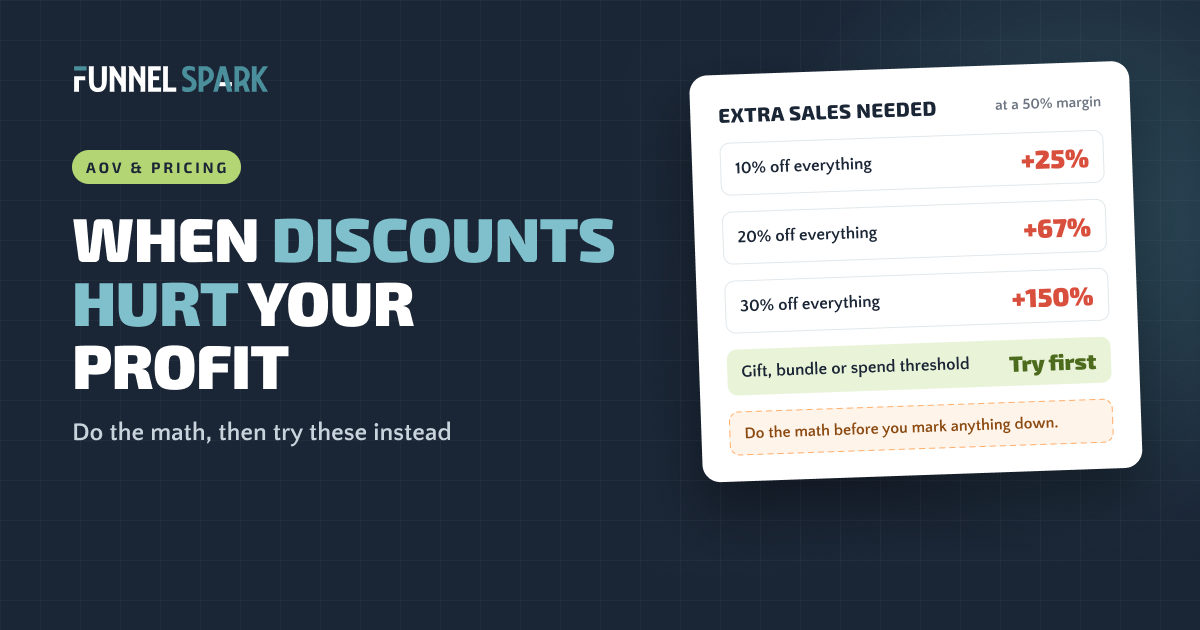
A good discount strategy uses discounts rarely, on purpose, and with the math done first. Discounts hurt when your margin is thin, when sales come so often that shoppers wait for the next one, and when most buyers would have paid full price. Try a gift, bundle or spend threshold first, and judge every offer on profit per visitor.
What is a discount strategy?
A discount strategy is your plan for when you lower prices, for whom, by how much, and why. Without one, discounts happen whenever sales feel slow, and the store ends up "on sale" half the year.
It's also called promotional pricing or discount pricing. Common forms: a sitewide sale, a dollar amount off, a code for one group (like new subscribers), a spend threshold ("spend $100, save $20"), quantity deals like BOGO, and bundles.
Do discounts increase sales?
Usually, yes. The real question is whether it brings in more profit.
Price is a powerful lever in both directions. In "The Power of Pricing," published in McKinsey Quarterly, Marn, Roegner and Zawada used the average S&P 1500 company to show that a 1% price rise would lift operating profit by 8% if sales volume held steady. They also point out the reverse: a 1% price cut would lower it by the same 8%. A small cut in price takes a big bite out of profit.
How much more do you need to sell to make up for a discount?
Here's the math most owners skip. Your margin is what's left of a sale after product cost, shipping and payment fees. A discount comes straight out of it, so you need more orders to earn the same profit. The formula: extra sales needed = discount ÷ (margin − discount).
| Your margin | 10% off | 20% off | 30% off |
|---|---|---|---|
| 30% | +50% | +200% | Never |
| 40% | +33% | +100% | +300% |
| 50% | +25% | +67% | +150% |
| 60% | +20% | +50% | +100% |
| 70% | +17% | +40% | +75% |
Extra sales needed just to make the same profit as before the discount. Our math, not test results. "Never" means the discount eats your whole margin.
At a 50% margin, 20% off needs 67% more orders just to break even. Very few sales do that. To compare a discount with a free gift or BOGO on the same product, see our worked example in BOGO vs gift with purchase vs discount.
When do discounts hurt? 5 warning signs
1. Your margin is thin
Look at the top rows of the table. Below about 40% margin, even a modest sale needs a huge jump in orders. Offers that add value beat offers that cut price.
2. Shoppers have learned to wait
This is discount fatigue. If there's always a code, full price starts to feel like the "wrong" price. In a study in the Journal of Marketing Research, Mela, Gupta and Lehmann tracked over 8 years of shopping data for a packaged good and found that consumers became more price and promotion sensitive over time as promotions increased. Sign to watch: sales drop sharply in the weeks between promos.
3. You're paying people who would have bought anyway
A sitewide sale gives the same cut to your loyal fans as to new shoppers. A big code box does too: Baymard Institute notes that promo fields are distracting and encourage some users to leave checkout to hunt for coupons. Some don't come back.
4. It makes your product look cheaper
Research in the Journal of the Association for Consumer Research found that when a brand is promoted often, shoppers can get used to a lower "normal" price, and a lower normal price tends to go with lower quality ratings. That matters most for premium and gift brands.
5. The discount is covering up a page problem
If people only buy during a sale, ask why. Often the product page doesn't answer questions about size, shipping or returns, and the discount does the convincing. Our guide to traffic but no sales walks through where to look.
When a store tells us sales only come in during a promo, the price is rarely the real problem. The page never gave people a good reason to buy at full price. Fix that first, and the discount becomes a choice, not a habit.
How do top stores show a deal?
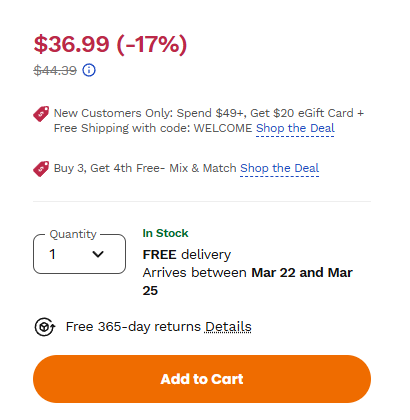
Of the 25 top stores we broke down page by page, 9 show a crossed-off price next to the sale price. When they discount, they make the saving easy to see, and the smart ones tie it to a bigger order.
What to do instead of a discount
You don't have to stop running offers. Pick ones that cost less, or only cost you when the order grows. Here's the order we'd try them in.
Try these before a sitewide sale
- 1
Fix the pageAnswer size, shipping and returns questions; show a guarantee
- 2
Free shipping thresholdCosts you only on orders above the line
- 3
Gift with a set spendThe gift's cost, only on bigger orders
- 4
Bundle or quantity dealA smaller cut, tied to buying more
- 5
Targeted codeA cut for one group, like new subscribers
- 6
Sitewide saleA cut on every order, even full-price buyers
Bar = margin given away per orderLeast → most
| Instead of… | Try | Why it's cheaper |
|---|---|---|
| 20% off everything | Free gift on orders over a set amount | You pay for the gift only when the order grows |
| Free shipping on everything | A free shipping threshold | Shoppers add items to qualify |
| A permanent sale price | A member or subscribe-and-save price | The cut buys you repeat orders |
| Cutting the price of a big-ticket item | A payment plan | The full price stays; the payment feels smaller |
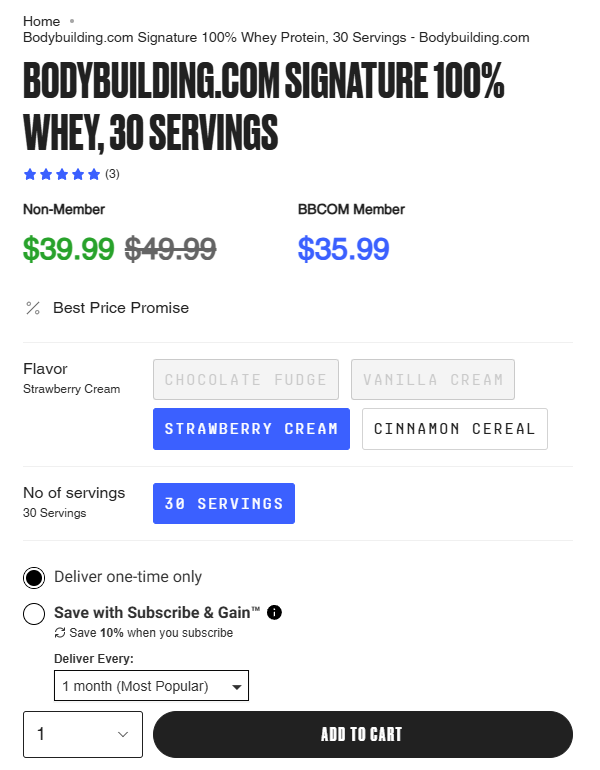
Of the 25 top stores we broke down, 11 offer payment plans, 15 show a free shipping threshold or confirm free shipping in the cart or checkout, and 12 make a guarantee or returns promise. Bodybuilding.com protects its price without a big sale:
More on how to increase average order value and price a bundle that still makes money.
Psychological pricing examples that protect your margin
These change how a price feels, not what you earn:
- End prices in 9. In 3 field experiments published in Quantitative Marketing and Economics, Anderson and Simester found that $9 price endings increased demand in all 3, with a stronger effect on new items.
- Drop the cents on premium items. 8 of the 25 top stores we broke down show prices without cents, including SKIMS, Gymshark and Fenty Beauty. "$68" reads cleaner than "$67.99".
- Show the reference price. A crossed-off price gives shoppers a comparison. Only show a price you really charged.
- Show the bigger-looking saving. "20% off" beats "$6 off" on a $30 item; "$80 off" beats "20% off" on a $400 item.
- Split the price. "4 payments of $25" feels smaller than "$100." 11 of the 25 top stores show payment plans.
- Show the price per use. A $39.99 tub with 30 servings is $1.33 a serving. Say so.
How to price your products
A good ecommerce pricing strategy starts before any promo:
- Work out your full cost per order. Product, packaging, payment fees, and any shipping you pay for.
- Pick a target margin and do the math. Price = cost ÷ (1 − margin). An item that costs you $18 at a 60% target margin sells for $45.
- Check the market. What do similar products sell for, and what does yours offer that they don't?
- Leave room for your planned offers. If you'll run 20% off for Black Friday, make sure your margin survives it. Use the table above.
- Round it with intent. Use a 9 ending or drop the cents.
How much discount should you offer?
The smallest one that changes behavior. Start lower than you think (10%, not 25%), or try a gift instead. Keep codes for moments where they earn their keep:
- An email sign-up. Crocs offers 15% off for joining its newsletter.
- A cart reminder. Hold any code for the last email, not the first. See our abandoned cart email examples.
- Black Friday. Shoppers expect a deal, so lead with a gift tier or "spend more, save more." Our Black Friday CRO checklist covers the rest.
On Shopify, discounts come in 3 types, according to Shopify's help center: amount off (products or the whole order), buy X get Y, and free shipping. Shopify says each type can run as a code or apply automatically in the cart and at checkout. Want to mention the offer next to the pay button? Shopify's one-page checkout is the default, and custom text inside the checkout steps needs Shopify Plus. On other plans, show it on the product page and in the cart.
How to test a discount
Revenue always looks good during a sale. Judge it by profit per visitor: revenue minus product, shipping and offer costs, divided by everyone who visited.
- Split your traffic. Half see the offer, half don't, at the same time. Before-and-after comparisons mix in seasons and ad changes.
- Test against a cheaper offer, like 15% off vs a gift over a set spend.
- Watch the weeks after. If orders dip once the sale ends, part of the lift was people buying earlier, not more.
- Check returns and repeat orders from deal buyers.
At FunnelSpark, an ecommerce CRO agency for Shopify stores, we call a test a win only when it beats the current page at 95% confidence on orders or revenue per visitor. You need traffic for that: proving a 10% lift at a 2% conversion rate takes about 161,000 visitors. With less, use customer feedback and faster signals like add-to-cart rate. More in our guide to ecommerce A/B testing.
FAQ
Your plan for when to lower prices, for whom, by how much and why. A good one uses discounts rarely, with the profit math done first.
Used rarely, yes: for clearing stock, email sign-ups or Black Friday. Run too often, they shrink your margin and teach shoppers to wait.
The smallest discount that changes behavior. At a 50% margin, 10% off needs 25% more sales to break even, while 20% off needs 67% more. Test a lower discount or a free gift first.
Prices ending in 9, no cents, a crossed-off reference price, showing the bigger-looking saving, payment plans and price per use.
Go to Discounts in your Shopify admin and pick a type: amount off products or the order, buy X get Y, or free shipping. Then choose whether it runs as a code or applies automatically.
Written by
Nicolas Fradet
Nicolas is the founder of FunnelSpark, an ecommerce CRO agency. He has spent 16 years finding out why shoppers don't buy, with 1,000+ A/B tests run and a 37% win rate. He wrote Stop Guessing. Start Converting.
Follow Nicolas on LinkedIn →Want us to find what's stopping your shoppers?
On a free 30-minute call, Nicolas looks at your store and shows you 3 growth opportunities, whether we work together or not.
Book your free call