BOGO vs gift with purchase vs discount: which offer makes you more money?
What each offer really costs you, judged on profit per visitor, plus what to run for Black Friday.

By Nicolas Fradet, founder of FunnelSpark · 16 years in CRO, 1,000+ A/B tests
Updated Nov 5, 2026 · 8 min read
The short answer
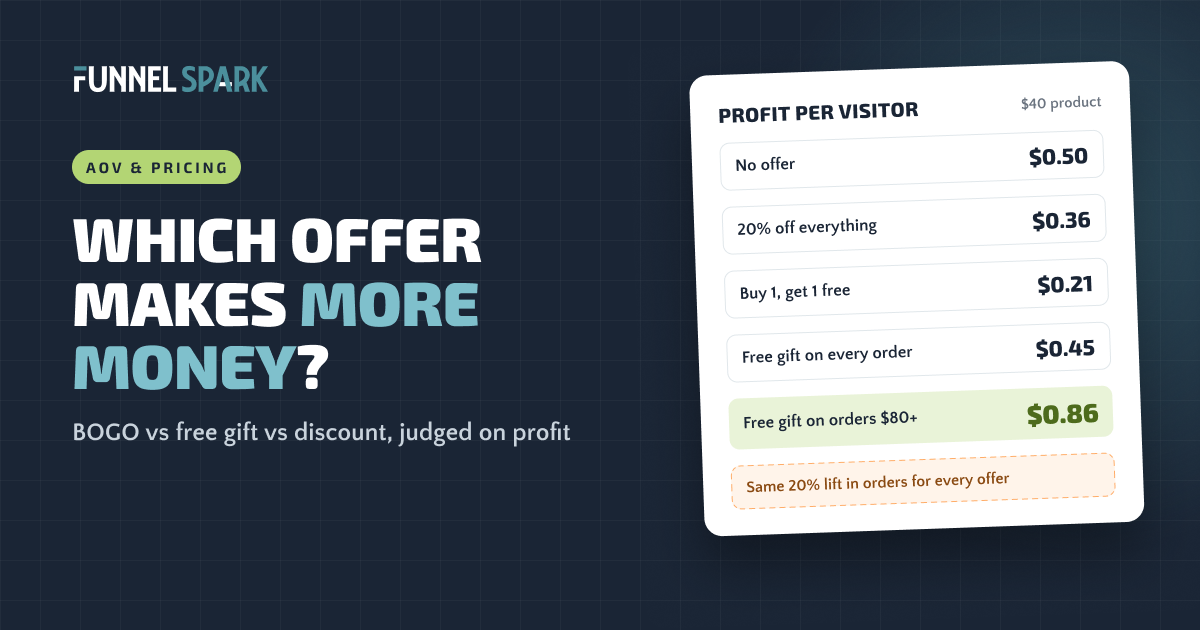
Most of the time, a gift with purchase set above your average order makes the most money. A discount or a "buy one, get one free" (BOGO) offer gives away margin on every order, so it needs far more extra orders just to break even. Whatever you run, judge it on profit per visitor, not on sales.
What do BOGO, GWP and discount mean?
These 3 offers sound alike, but they hit your profit in very different ways.
- BOGO means "buy one, get one." The shopper buys 1 item and gets a second one free (BOGO free) or at a lower price (like "buy 1, get 1 50% off").
- GWP means "gift with purchase." The shopper gets a free item with their order, often once they spend a set amount. Think of a free sample with orders over $75.
- A discount cuts the price: 20% off, $10 off, or a code. It's the easiest to launch and to understand.
The big difference: a discount and BOGO free give money back on every order. A gift costs you only the gift, and a spend threshold can push shoppers to buy more first.
How the 3 offers compare
| Offer | What it costs you | Best for |
|---|---|---|
| Discount | The full discount on every order, even from people who would have paid full price | Clearing stock, price-driven shoppers |
| BOGO free | A whole extra unit plus its shipping, on every order | Cheap-to-make items, moving old stock |
| BOGO 50% off | Part of the price of a second unit, only when they buy 2 | Raising order value on repeat-use products |
| Gift with purchase | The cost of the gift, only on orders that qualify | Protecting your price, raising order value |
There's also a reason shoppers often like "more for free" better than "less to pay." In a field test reported in the Journal of Marketing by Chen, Marmorstein, Tsiros and Rao, a hand lotion sold about 1.8 times as many units per week with a "50% more free" bonus pack (3.38 units) than with 35% off (1.88 units), even though 35% off was the slightly better deal.
Which offer makes the most money? A worked example
An offer can bring in more orders and still leave you with less money. So let's run the numbers on a simple store and compare offers on profit per visitor: the profit you keep, divided by everyone who visited.
The store sells a $40 product that costs $12 to make. Shipping and packing cost $8 an order (plus $1 for a second item). With no offer, 2.5% of visitors buy. Every offer gets the same 20% lift in orders, so only the cost changes.
| Offer | Avg order | Profit per order | Extra orders to break even | Profit per visitor |
|---|---|---|---|---|
| No offer | $40 | $20.00 | n/a | $0.50 |
| 20% off everything | $32 | $12.00 | +67% | $0.36 |
| Buy 1, get 1 free | $40 | $7.00 | +186% | $0.21 |
| Free gift on every order | $40 | $15.00 | +33% | $0.45 |
| Buy 1, get 1 50% off | $48 | $22.80 | None | $0.68 |
| Free gift on orders $80+ | $56 | $28.80 | None | $0.86 |
Our worked example, not test results. The gift costs you $5. Each offer lifts orders 20% (from 2.5% to 3% of visitors), except "No offer." For the 2-item offers, we assume 40% of buyers add the second item. Payment fees left out.
Three things jump out:
- BOGO free is the most expensive offer here. It sounds generous because it is. Profit per order drops from $20 to $7.
- A 20% discount loses money even with 20% more orders. Profit per visitor falls from $0.50 to $0.36.
- Offers that ask for a bigger order win. They only cost you something when the shopper buys more.
One catch with the 2-item offers: some shoppers would have bought 2 at full price anyway. For them, the deal is pure cost. A test tells you how many second items are true extra sales. This is also why average order value and conversion rate belong together: multiply them and you get revenue per visitor.
How many extra orders does an offer need to break even?
Run this before any promotion. Take your profit per order with no offer, divide it by your profit per order with the offer, and subtract 1. That's the extra orders you need just to stay even.
In our example, 20% off drops profit per order from $20 to $12. $20 ÷ $12 = 1.67, so you need 67% more orders just to make the same money. That's a big jump to ask of any offer.
Extra orders each offer needs just to break even
Free gift on every order (gift costs $5)
+33%
20% off everything
+67%
Buy 1, get 1 free
+186%
Free gift on orders $80+ (profit per order goes up)
None
A discount is the easiest offer to launch and the most expensive one to keep. Before you run one, work out how many extra orders it needs just to break even. Most owners never do that math.
How top stores use a free gift
Of the 25 top stores we broke down page by page, 2 show a free gift already applied in the cart: Venus et Fleur and Blueland. That's a small number, so a well-placed gift can still stand out.
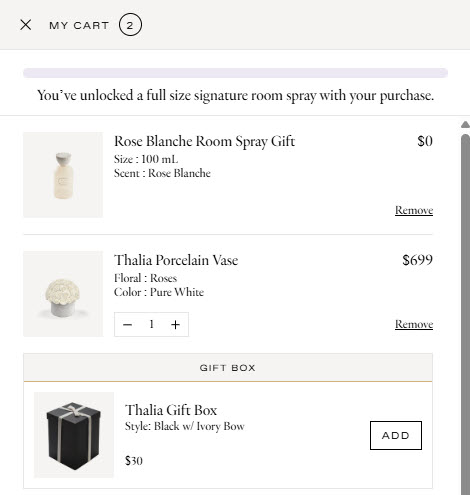
Venus et Fleur doesn't cut the price of a $699 vase. It adds something that feels valuable and shows it in the cart. Its homepage also promotes a gift for bigger purchases, so shoppers see the offer early.
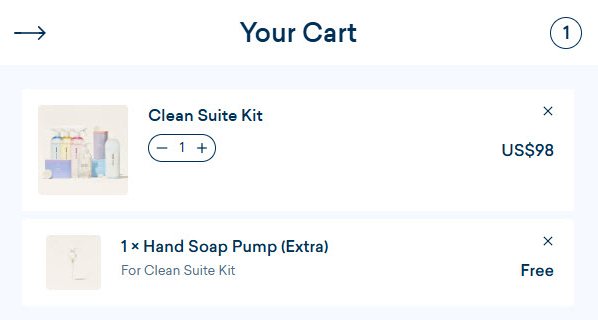
Both gifts are things that go with the product: a room spray with flowers, a pump with a soap kit. A related gift feels like part of the deal. And gifts sit next to other ways to raise order value: 22 of the 25 stores suggest an upsell or cross-sell before checkout. (Here's the difference between upsells and cross-sells.)
When to use each offer
- Use a gift with purchase when you want to protect your price, or when your margins are thin. Pick a gift that costs you little but looks valuable, and set the threshold a little above your average order, at a number most shoppers can reach by adding one more item. The same logic as setting a free shipping threshold applies.
- Use "buy 1, get 1 50% off" for products people use up and buy again: coffee, skincare, supplements, socks. It asks for a bigger order, and the second unit is often a real extra sale.
- Use BOGO free only for items that cost you very little, or stock you need to clear.
- Use a discount for clearing old stock or for a short, rare event. Discount every month and shoppers stop paying full price.
Show the offer on the product page and in the cart, not only at checkout. For more ways to lift order size, see our guide on how to increase average order value.
How to set up BOGO or a free gift on Shopify
Shopify's built-in "Buy X get Y" discount handles both. According to Shopify's help center, you can trigger it with a minimum quantity or a minimum purchase amount, and the "get" item can be free, a percentage off or an amount off. Here's the setup:
- Go to Discounts and create a "Buy X get Y" discount.
- Set the trigger. For BOGO, use a minimum quantity of 1 on the product. For a gift with purchase, use a minimum purchase amount, like $80.
- Set what they get. Pick the item, then choose "Free" or a percentage off.
- Limit it. Set a maximum number of uses per order, so nobody stacks 10 free gifts.
- Make sure shoppers add the item. Shopify's help center is clear that the free or discounted "get" item is never added to the cart automatically. Tell shoppers to add it, or use a free gift app that adds it for them.
Want a line about the gift next to the pay button? Shopify's one-page checkout is the default, and custom text inside the checkout steps needs Shopify Plus. On other plans, use the product page and cart.
Which offer should you run for Black Friday?
Black Friday is when shoppers expect a deal, so it's tempting to slash prices. But when every store is shouting "30% off," one more percentage is easy to scroll past, and it comes straight out of your margin. Here's a smarter plan:
- Lead with a gift tier. "Free gift on orders over $80" stands out and protects your price.
- If you must discount, make it ask for more. "Buy 1, get 1 50% off" or "spend $100, save $20" lifts order value instead of only cutting it.
- Keep the offer visible. Announce it in the top bar, on product pages and in the cart.
For everything else to fix before the rush, use our Black Friday CRO checklist.
How to test an offer
The table above is a model. Your shoppers decide the real result. With enough traffic, A/B test the offer: half your visitors see it, half don't, at the same time. Then judge it by profit per visitor, after the cost of the discount or gift, not by orders.
At FunnelSpark, an ecommerce CRO agency for Shopify stores, we call a test a win only when it beats the current page at 95% confidence on orders or revenue per visitor. For offers, we also count the cost of the gift or discount. More in our guide to ecommerce A/B testing.
FAQ
BOGO means "buy one, get one." The shopper buys 1 item and gets a second one free or at a lower price, like 50% off.
GWP stands for gift with purchase: a free item added to an order, often once the shopper spends a set amount, like a free sample on orders over $75.
"Buy 1, get 1 50% off" often makes more money than a discount, because it only costs you when the shopper buys more. "Buy 1, get 1 free" is usually the most expensive offer of all.
Create a "Buy X get Y" discount, set a minimum purchase amount as the trigger, pick the gift and set it to free. Shopify never adds the gift to the cart for you, so tell shoppers to add it, or use a free gift app that adds it automatically.
A gift on orders over a set amount, or "buy 1, get 1 50% off," usually beats a big sitewide discount or "buy 1, get 1 free." Do the break-even math before you launch.
Written by
Nicolas Fradet
Nicolas is the founder of FunnelSpark, an ecommerce CRO agency. He has spent 16 years finding out why shoppers don't buy, with 1,000+ A/B tests run and a 37% win rate. He wrote Stop Guessing. Start Converting.
Follow Nicolas on LinkedIn →Want us to find what's stopping your shoppers?
On a free 30-minute call, Nicolas looks at your store and shows you 3 growth opportunities, whether we work together or not.
Book your free call