Bundle pricing: how to price product bundles that raise AOV
The types of bundles, the discount math (with a worked example), and where to show bundles so shoppers actually buy them.

By Nicolas Fradet, founder of FunnelSpark · 16 years in CRO, 1,000+ A/B tests
Updated Nov 9, 2026 · 8 min read
The short answer
Bundle pricing means selling 2 or more products together for one price, usually a little below what they cost apart. To price a bundle, work out the profit the extra items add, keep your discount well under it, show the savings in dollars, and judge the bundle on profit per visitor, not on orders.
What is bundle pricing?
Bundle pricing is selling a group of products as one item, for one price. Think of a skincare routine sold as a set, a grill with its cover, or 3 bags of coffee for less than 3 single bags.
Product bundling is deciding which products go together. Bundle pricing is deciding what to charge for the set, so it raises your average order value (AOV) without giving away your profit. The shopper saves a little and skips the "what goes with what" work. You get a bigger order. It's one of the 7 moves in our guide on how to increase average order value.
The 5 types of product bundles
| Bundle type | Example | Best for |
|---|---|---|
| Fixed bundle (kit) | A 3-step skincare routine sold as one product | New customers who don't know what to pick |
| Mix and match | "Pick any 3 candles for $60" | Stores with lots of similar products in different flavors, scents or colors |
| Multipack | 3 bags of the same coffee for less | Things people use up and buy again |
| Add-on bundle | A phone case plus the matching screen protector | A main product with an obvious partner |
| Gift set | A boxed set for the holidays | Gift seasons and shoppers buying for someone else |
You'll also hear 2 terms from economics. Pure bundling means the items are only sold together. Mixed bundling means shoppers can buy the bundle or each item on its own. Almost every online store should use mixed bundling. Forcing the whole set on people loses the ones who wanted one thing. (An add-on bundle is close to a cross-sell: here's the difference between an upsell and a cross-sell.)
How to price a bundle: a worked example
Most stores pick a bundle discount by gut feel. Here's a better way, using a simple skincare store.
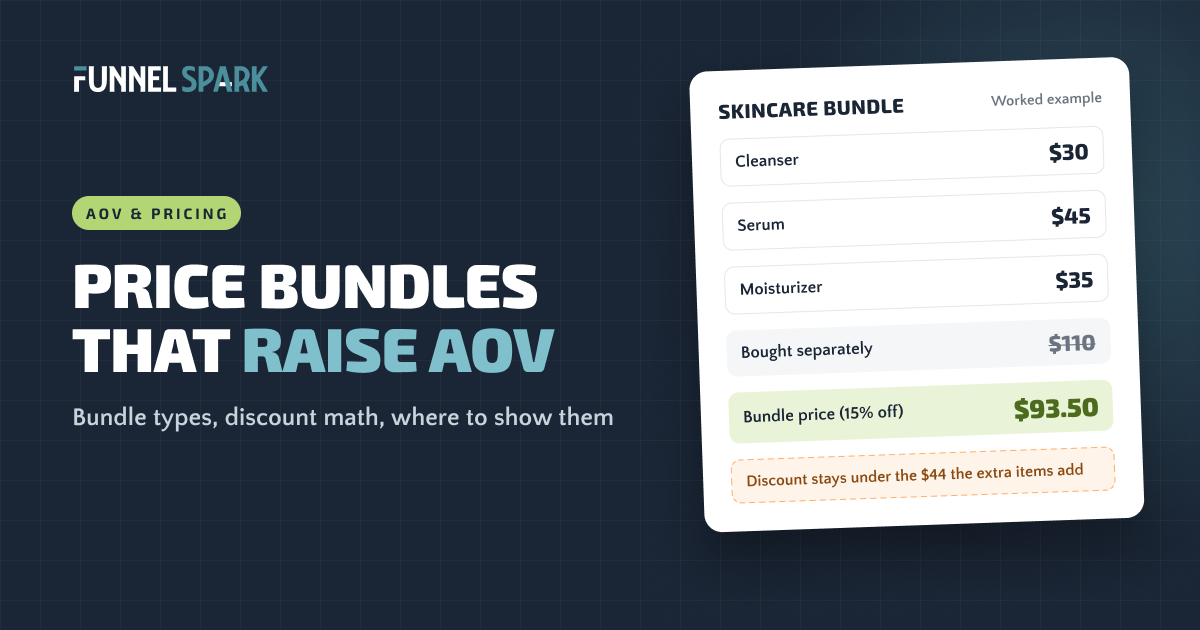
The store sells a cleanser ($30, costs $9 to make), a serum ($45, costs $12) and a moisturizer ($35, costs $10). Bought separately, the 3 come to $110. Shipping and packing cost $8 an order, plus $1 for each extra item. Most shoppers come in for the serum.
A serum-only order leaves $25 of profit. An order for all 3 at full price leaves $69. So the 2 extra items add $44 of profit. That $44 is your budget. Every dollar of bundle discount comes out of it.
| Bundle discount | Bundle price | Your profit per bundle | vs. a serum-only order | vs. a full-price order of all 3 |
|---|---|---|---|---|
| 10% off | $99.00 | $58.00 | +$33.00 | −$11.00 |
| 15% off | $93.50 | $52.50 | +$27.50 | −$16.50 |
| 20% off | $88.00 | $47.00 | +$22.00 | −$22.00 |
| 30% off | $77.00 | $36.00 | +$11.00 | −$33.00 |
| 40% off | $66.00 | $25.00 | $0.00 | −$44.00 |
Our worked example, not test results. Payment fees left out.
When a shopper who came for the serum takes the bundle, you win. When a shopper who would have bought all 3 anyway takes it, you just gave them a discount. At 40% off, the bundle can't make you a cent more.
How big should the bundle discount be?
A bundle pays off when enough of its buyers are "upgraders": people who would have bought less without it. Here's the quick test: divide your discount in dollars by the profit the extra items add. That's the share of bundle buyers who need to be upgraders for you to break even.
At 15% off, the shopper saves $16.50. $16.50 ÷ $44 = 37.5%. So if at least 3 in 8 bundle buyers came in for just the serum, the bundle makes you money. At 20% off, you need half of them. At 30% off, you need 3 in 4.
Who wins when a shopper takes the 15% bundle
Shopper A came in for the serum only
No bundle
$25.00
Takes bundle
$52.50
Shopper B would have bought all 3 anyway
No bundle
$69.00
Takes bundle
$52.50
Break-even point share of bundle buyers who must be like shopper A
0%37.5%100%
Below: the discount costs youAbove: the bundle pays
Shoppers who wouldn't have bought at all, but the bundle tipped them over, are pure extra profit, so reality can be better than this. Still, start with a small discount. You can always go deeper, but it's hard to raise a bundle price once shoppers are used to it.
A bundle should save the shopper a decision, not just money. If people can't tell why these items belong together, a bigger discount won't fix it.
How to make a bundle price feel like a deal
- Show the full price, crossed off. Of the 25 top stores we broke down page by page, 9 show crossed-off prices.
- Say what they save. "Save $16.50" needs no math. Test it against "15% off."
- List what's inside, each item with a photo and one line on what it does.
- Round the price. 8 of the 25 top stores we broke down hide the cents. $94 reads cleaner than $93.50.
- Offer 3 sizes. A starter set, a full routine and a deluxe set turn "buy or leave" into "which one?"
Shoppers judge prices by comparing them. In his book Predictably Irrational, behavioral economist Dan Ariely describes an Economist subscription offer: web only for $59, print only for $125, or print and web for $125. With all 3 options, 84 of 100 people picked print and web. With the print-only option removed, only 32 did, and 68 took the cheaper web-only plan. Nobody chose print only, but it made the bundle look like a steal.
What a top store's bundle looks like
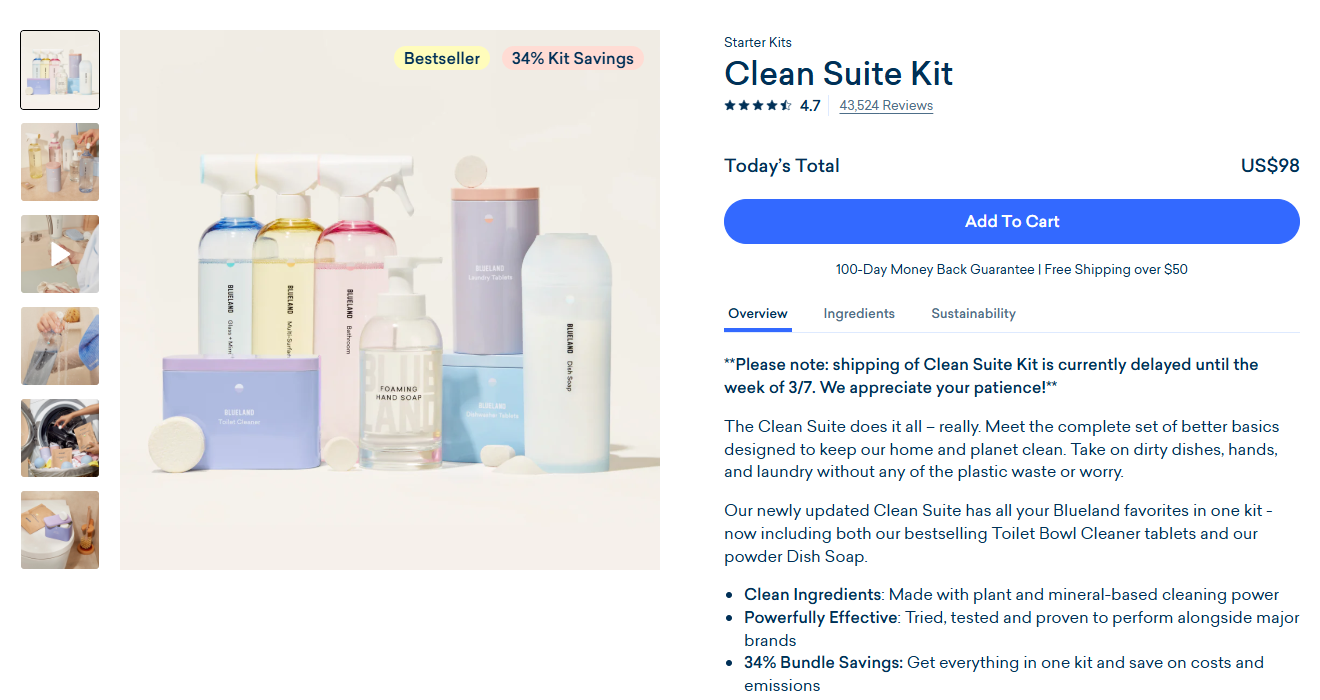
Blueland sells its Clean Suite Kit as a fixed bundle and gets a lot right: the saving sits on the product photo, the price is one round number, and the description repeats the saving.
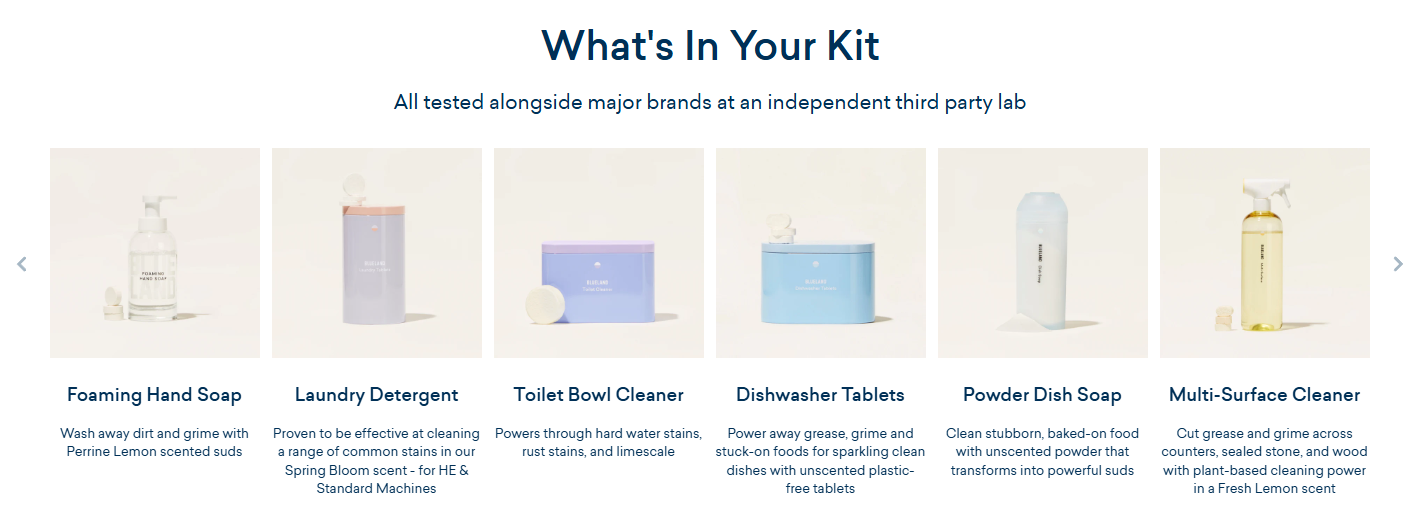
Further down, Blueland shows each product in the kit, so the shopper sees the value add up. Its main menu even has a "Bundle & Save" link.
Which products should you bundle?
- Start with what people already buy together. Look at your orders with 2 or more items for pairs that keep showing up.
- Build around your best seller, plus the items that make it work better.
- Make a starter kit for new customers who don't know where to begin.
- Bundle refills of things people use up, as multipacks.
- Go easy on slow sellers. 1 can ride along in a strong bundle. Several make the whole set look cheap.
Where to show bundles on your store
Top stores suggest extra items early and often: of the 25 top stores we broke down, 22 suggest an upsell or cross-sell before checkout, and 19 do it in the cart itself.
- On the product page, next to the buy button. Show it as an option beside the single item ("Full routine $94, save $16") while the shopper is still choosing. More in our product page optimization guide.
- In the cart: "Complete the routine and save $16."
- In your menu, like Blueland's "Bundle & Save" link, and on the homepage in gift season.
- In checkout, if you're on Shopify Plus. 7 of the 25 top stores we broke down run an order bump in checkout. On Shopify, one-page checkout is the default, and adding offers or custom text inside the checkout steps, near the pay button, needs Shopify Plus. On other plans, use the product page and cart.
A free gift can stand in for a bigger discount: see BOGO vs gift with purchase vs discount. And if you have a free shipping threshold, price your main bundle just above it, so the bundle also unlocks free shipping.
How to create bundles on Shopify
Shopify's help center says you need a bundles app to sell bundles. Its own app, Shopify Bundles, is free, works on all Shopify plans, and makes fixed bundles and multipacks. The basics:
- Install Shopify Bundles, or a third-party app that lists mix and match if you want build-your-own boxes.
- Create the bundle and pick the products in it. According to Shopify's help center, a fixed bundle can hold up to 30 products, with up to 3 options and 100 variants.
- Set the price by hand, or with a discount code or automatic discount. Shopify splits a bundle discount across the items by price.
- Write the bundle page: a name that says the result ("Full routine"), the crossed-off total, and what's inside.
- Recheck prices. Shopify's help center notes that when a bundled product's price changes, the bundle price doesn't update. You change it by hand.
How to test bundle pricing
The worked example is a model. Your shoppers decide the real result. The cleanest test shows the bundle (or 2 discount levels) to half your visitors at the same time.
Don't judge it by bundle sales: a bundle can sell well and still lose money. Look at revenue per visitor (AOV times conversion rate) and, better still, profit per visitor after the discount. Here's why revenue per visitor beats conversion rate.
At FunnelSpark, an ecommerce CRO agency for Shopify stores, we only call a test a win when it beats the current page at 95% confidence on orders or revenue per visitor. That takes traffic: proving a 10% lift at a 2% conversion rate takes about 161,000 visitors. With less, launch at a modest discount, watch AOV and profit for a few weeks, and adjust. Our guide to ecommerce A/B testing covers the rest, and our revenue calculator shows what a higher AOV would add to your revenue.
FAQ
Bundle pricing is selling 2 or more products together for one price, usually a bit lower than the total of the items bought separately. Online stores use it to raise average order value.
Keep it well under the profit the extra items add. Divide the discount in dollars by that profit: that's the share of bundle buyers who must be people who would have bought less without it. Start small and test.
With pure bundling, the items are only sold as a set. With mixed bundling, shoppers can buy the set or each item on its own. Most online stores should use mixed bundling.
Install a bundles app. Shopify's own Shopify Bundles app is free on all plans and makes fixed bundles and multipacks. Update the bundle price by hand when a product's price changes.
They can, but they only make you more money if enough bundle buyers would have bought less without them. Judge them on revenue or profit per visitor.
Written by
Nicolas Fradet
Nicolas is the founder of FunnelSpark, an ecommerce CRO agency. He has spent 16 years finding out why shoppers don't buy, with 1,000+ A/B tests run and a 37% win rate. He wrote Stop Guessing. Start Converting.
Follow Nicolas on LinkedIn →Want us to find what's stopping your shoppers?
On a free 30-minute call, Nicolas looks at your store and shows you 3 growth opportunities, whether we work together or not.
Book your free call