How to set your free shipping threshold (without killing conversions)
A simple way to pick the number, show it to shoppers, and test it before you roll it out.

By Nicolas Fradet, founder of FunnelSpark · 16 years in CRO, 1,000+ A/B tests
Updated Oct 27, 2026 · 7 min read
The short answer
Set your free shipping threshold a little above your average order value, at a number most shoppers can reach by adding one more item. Show it everywhere shoppers look: the announcement bar, the product page and the cart, with a bar that says how much is left. Then A/B test it, and judge it on revenue and profit per visitor, not conversion rate alone.
What is a free shipping threshold?
It's the order total a shopper has to reach to get free shipping. "Free shipping on orders over $75" is a threshold. Below it, the shopper pays for shipping. Above it, you do.
Done right, it gives people a reason to add one more item. Done wrong, it shows up as a surprise cost at checkout, and that's exactly where shoppers leave.
Why it works, and why it can backfire
People hate paying for shipping. It feels like paying for nothing. Many shoppers would rather spend $15 more on a product they can keep than $8 on shipping.
That same feeling is why shipping costs kill sales. In Baymard Institute's checkout research, 40% of US shoppers who abandoned an order said extra costs, like shipping, taxes and fees, were too high. It's the number 1 reason people leave.
So a threshold cuts both ways. It can raise your average order. Or, if it's too high or shows up too late, it can push people out the door.
Does a free shipping threshold increase average order value?
It can. That's the whole point of it. Shoppers who are close to the threshold add a little more to reach it, so the typical order gets bigger.
But the conversion impact cuts both ways. Some shoppers who would have bought one item at full shipping now leave instead. So a threshold can raise your average order value and lower your conversion rate at the same time.
That's why you can't judge it on one number. Look at revenue per visitor, which combines both, and at profit once you pay for the free shipping. A threshold is only a win if those go up.
top online stores we broke down show a free shipping threshold, or confirm free shipping in the cart or checkout. Source: FunnelSpark's page-by-page breakdown of 25 brand funnels.
How to calculate your threshold
You don't need a formula. You need 4 numbers from your store, and about 20 minutes.
- Find your average order value. Look at the median too. A few big orders can make the average look higher than what most people actually spend.
- Find your most common add-on. What do people often add to an order? Note its price. That's how far most shoppers can stretch without thinking twice.
- Pick a clean number just above your average. Somewhere between your average order and your average plus one add-on. Round numbers like $50, $75 or $100 are easy to remember.
- Check the math. On every order that reaches the threshold, you now pay the shipping. Make sure the extra products people add bring in enough profit to cover it.
Where to set your threshold
Average order
Average + add-on
Example (a made-up store, to show the math)
| Average order value | $62 |
| Most common add-on | $18 |
| Threshold (a clean number between $62 and $80) | $75 |
| Shipping cost you now pay on qualifying orders | $9 |
| Extra products added ($75 − $62), at a 55% margin | about $7 profit |
On its own, each qualifying order loses about $2. The threshold only pays off if it also brings in orders that wouldn't have happened at all, or gets people to spend well past $75. You won't know which until you test it.
Where to show it
A threshold nobody sees doesn't change anything. Show it at every step, so shoppers know about it before they decide what to buy.
- The announcement bar. The thin bar at the top of every page. 18 of the 25 top stores we broke down use one, often for shipping.
- The product page. Near the price or the add to cart button, where people decide.
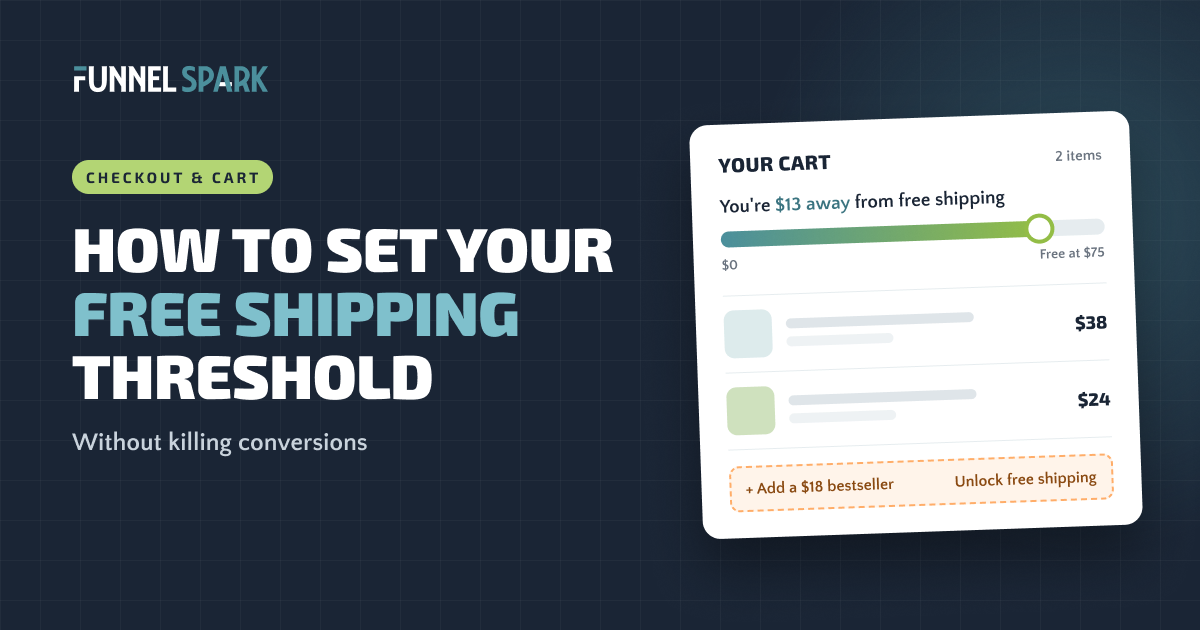
- The cart. A progress bar that says "You're $13 away from free shipping" turns the threshold into a small goal.
- The checkout. Once they qualify, confirm it: "Free shipping applied." No surprises at the last step.
How top stores show their free shipping threshold
When we broke down 25 top online stores page by page, free shipping came up again and again. Here's how some of the best-known brands handled it.
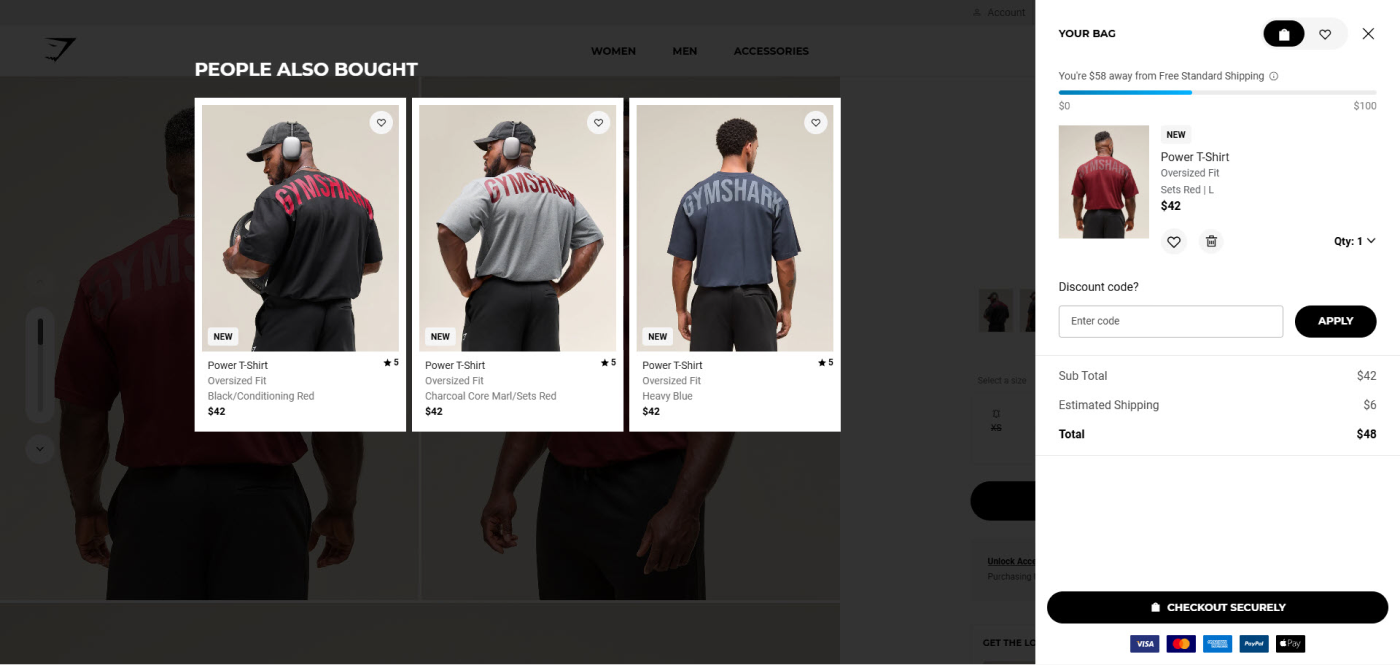
- Gymshark put the threshold in the announcement bar, then showed a progress bar in the cart.
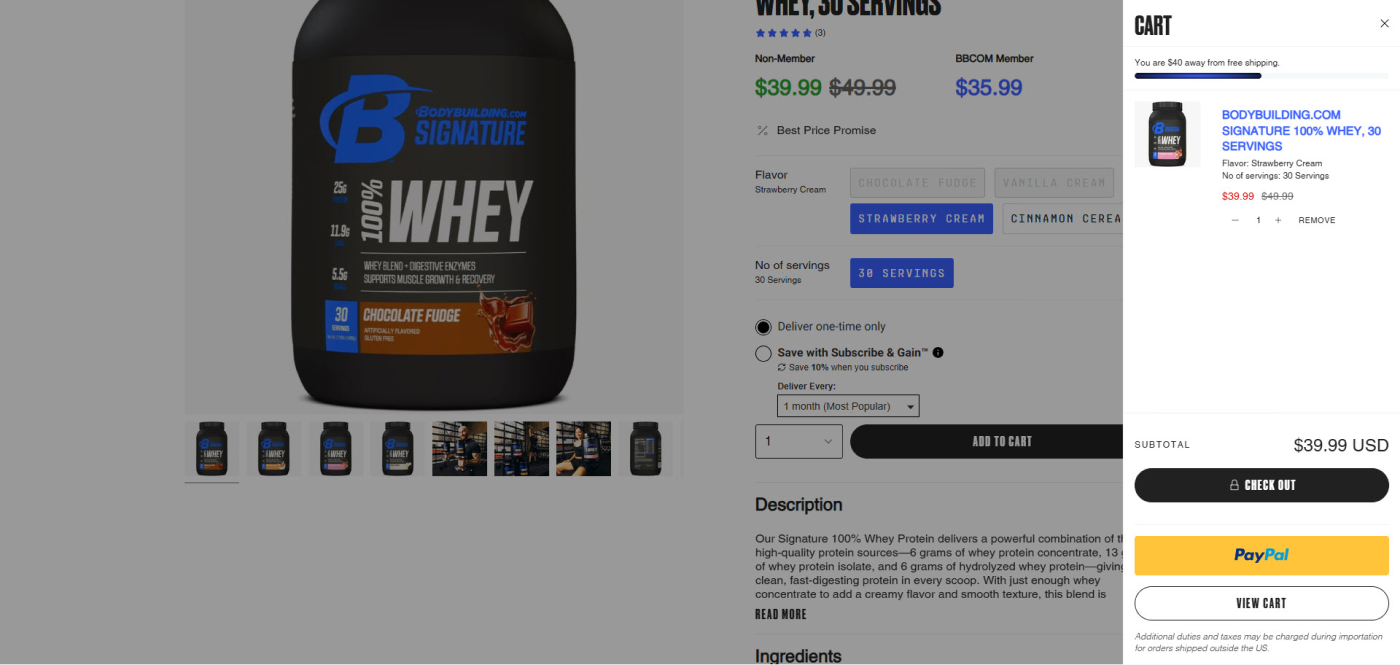
- Bodybuilding.com used a cart progress bar ("You are $40 away from free shipping") plus a free shipping offer in the announcement bar.
- Chewy spelled out the threshold on the page, then confirmed free shipping once the order qualified.
- SKIMS and Culture Kings showed threshold copy where shoppers make decisions, with shipping details close by.
- Black Rifle Coffee ran a free shipping threshold banner, a classic way to raise the average order.
- Decathlon paired its threshold with returns copy, answering 2 worries at once.
- Kylie Cosmetics, Crocs, KEEN, McCormick, Cambridge Satchel, Hawthorne and Frank & Oak all confirmed free shipping in the cart or checkout, so there was no doubt at the last step.
The pattern is the same every time: tell shoppers the number early, show their progress, and confirm it when they get there.
Free shipping threshold vs flat rate vs always free
A threshold isn't your only option. Here's how the 3 common setups compare.
| Option | How it works | Best for | Watch out for |
|---|---|---|---|
| Free shipping threshold | Free above a set order total, paid below it | Stores where shoppers often buy 2+ items | Set too high, it feels like a penalty |
| Flat rate | One shipping price on every order, like $5 | Simple pricing, low-cost items | Still a cost shoppers see at checkout |
| Always free | Shipping built into your product prices | Higher-priced products, mostly 1 item per order | Your prices look higher next to competitors |
Many stores combine them: a flat rate below the threshold, free shipping above it. Whatever you pick, show it clearly before checkout.
When a threshold hurts sales
A threshold isn't always a win. Watch for these 4 situations.
- It's set too high. If shoppers need 2 or 3 more items to reach it, most won't try. They just feel punished for buying less.
- Shipping only shows up at checkout. Then the threshold doesn't nudge anyone. It just becomes the surprise cost that makes them leave.
- Your competitors ship free on everything. Shoppers compare. A threshold can look stingy next to "free shipping, no minimum."
- Most people buy one item. If you sell one big-ticket product, there's often nothing to add. Free shipping built into the price may work better.
How to test it
The only way to know your best threshold is to test it on your own shoppers. Here's how we'd set it up.
- Test 2 or 3 levels. For example, your current threshold against one a little lower and one a little higher.
- Measure the right thing. Look at revenue per visitor and profit per visitor. A lower threshold can raise your conversion rate and still lose you money.
- Run it for full weeks. Shoppers behave differently on a Tuesday and a Saturday. Run at least 2 full weeks, longer if your traffic is low.
- Use a tool that can change shipping rates. On Shopify, testing tools like Intelligems can test shipping rules. A standard page testing tool can only test how you show the threshold.
Of the 1,000+ A/B tests we've run, 37% won. That's well above the industry average of about 15%, and it still means most ideas fail. That's exactly why testing beats guessing.
FAQ
Often, yes. Many shoppers value free shipping more than a discount worth the same amount, because paying for shipping feels like paying for nothing. But it depends on your store, so test both.
It can, because shoppers near the threshold add items to reach it. But it can also lower your conversion rate, so judge it on revenue per visitor and profit, not average order value alone.
Yes, a little above it. That's what pushes people to add an item. Set it too far above, and most shoppers won't bother trying to reach it.
On the announcement bar, on the product page near the price, and in the cart with a progress bar. Then confirm it at checkout once the shopper qualifies.
At least 2 full weeks, so you capture both weekday and weekend shoppers. Stores with less traffic need longer to get a clear answer.
Written by
Nicolas Fradet
Nicolas is the founder of FunnelSpark, an ecommerce CRO agency. He has spent 16 years finding out why shoppers don't buy, with 1,000+ A/B tests run and a 37% win rate. He wrote Stop Guessing. Start Converting.
Follow Nicolas on LinkedIn →Want us to find what's stopping your shoppers?
On a free 30-minute call, Nicolas looks at your store and shows you 3 growth opportunities, whether we work together or not.
Book your free call