Break-even ROAS: how to calculate it (and why CRO lowers it)
The formula, a free calculator, and the 2 numbers on your store that decide how much your ads can cost.

By Nicolas Fradet, founder of FunnelSpark · 16 years in CRO, 1,000+ A/B tests
Updated Nov 12, 2026 · 8 min read
The short answer
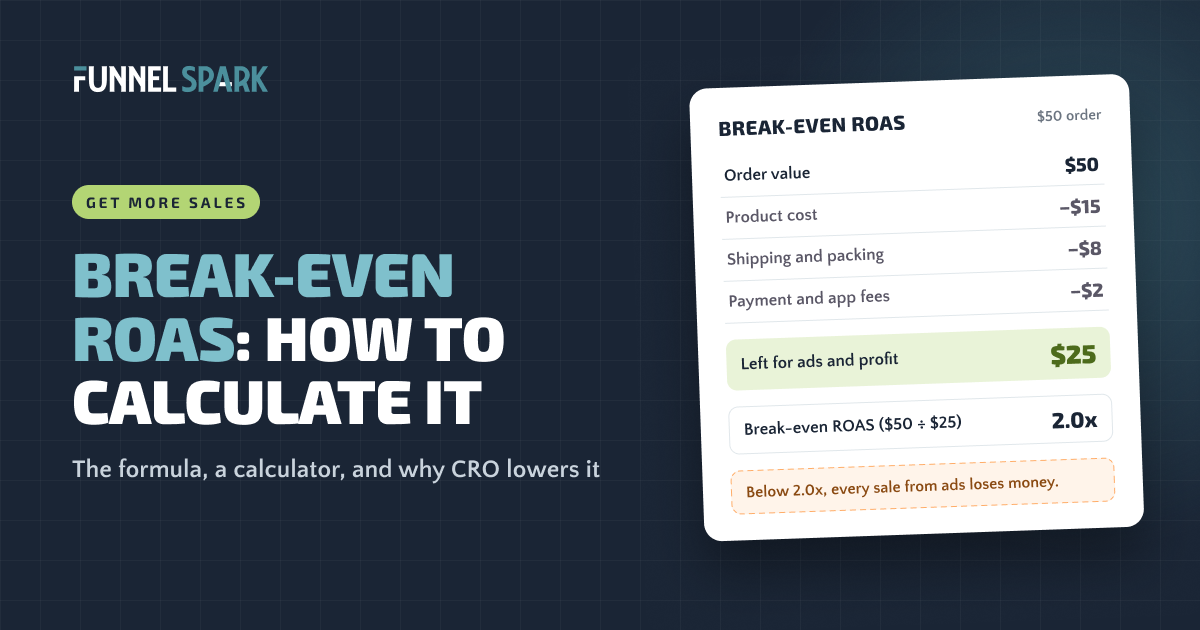
Break-even ROAS is the return on ad spend where your ads pay for themselves and nothing more. The formula: 1 ÷ your profit margin before ad spend. A $50 order that leaves $25 after product cost, shipping and fees has a 50% margin, so it breaks even at a ROAS of 2.0. Anything above that is profit.
What is ROAS, and what is break-even ROAS?
ROAS stands for return on ad spend. It's the revenue your ads bring in, divided by what you paid for them. Google's own help page on Target ROAS uses this example: $5 in sales for every $1 in ad spend is a ROAS of 500%, which most store owners write as 5.0 or 5x.
The catch: ROAS counts revenue, not profit. A ROAS of 3 sounds great, but if costs eat 70% of every order, each ad sale loses money.
That's where break-even ROAS comes in. It's the ROAS where the profit from an order exactly covers the ad cost to get it. Above it, your ads make money. Below it, they cost you money. Shopify's guide to target ROAS calls it "the absolute floor where your business makes zero profit but loses no money on its acquisition marketing."
How to calculate break-even ROAS
The formula is short:
Break-even ROAS formula
Break-even ROAS = 1 ÷ profit margin before ad spend
Or, the same thing in dollars: average order value ÷ profit per order before ads.
Shopify's guide uses the same formula and is clear that the margin is the one you have before any ad costs. Here's how it works on a simple store. An average order is $50. The product costs $15. Shipping and packing cost $8. Payment and app fees take 4%, or $2. That leaves $25 to pay for the ad and keep as profit.
Where a $50 order goes
So this store needs at least $2 in sales for every $1 it spends on ads. The $25 is also your break-even cost per order (break-even CPA): the most you can pay in ads to get one order without losing money.
Break-even ROAS calculator
Put in your own numbers. Use averages per order from the last 30 to 90 days.
Free calculator
What's your break-even ROAS?
Profit per order before ads $25.00
Margin before ads 50.0%
Max ad cost per order $25.00
You need at least $2.00 in sales for every $1 you spend on ads. Below that, every sale from ads loses money.
Break-even ROAS = average order value ÷ (average order value − product cost − shipping − fees). It covers your costs per order, not rent, salaries or apps you pay for monthly.
Write the number down. It's the floor for every campaign you run.
What costs should you include in break-even ROAS?
Include every cost that comes with one more order. Leave out costs you'd pay anyway.
- Product cost. What you paid for the items in the order.
- Shipping and packing. What you pay the carrier, plus boxes and fulfillment fees.
- Payment fees. Your card processing rate. Check your own rate in your payment settings, because it changes by plan and country.
- Per-order app fees. Some apps charge a percentage of each sale, like some reviews, upsell or subscription apps.
- Returns and discounts. If 10% of orders come back, or most shoppers use a code, take the average cost off your order value first.
Rent, salaries and monthly app plans don't change with one more order, so they stay out of break-even ROAS. They still need paying, which is why break-even is a floor, not a goal.
What is a good ROAS?
There's no single good number, because it depends on your margin. A ROAS of 2.5 is a great result for a store with a 60% margin and a loss for a store with a 30% margin. Here's how margin sets the floor:
Your margin before ads sets your break-even ROAS
| Profit margin before ads | Break-even ROAS |
|---|---|
| 20% | 5.0 |
| 25% | 4.0 |
| 33% | 3.0 |
| 40% | 2.5 |
| 50% | 2.0 |
| 60% | 1.67 |
1 ÷ margin. The thinner your margin, the faster the ROAS you need climbs.
So a good ROAS is one comfortably above your break-even, with enough room left to pay your fixed costs and keep a profit. Many store owners set a target ROAS a bit above break-even and use that as the number in Google Ads or Meta.
One exception: if your customers buy again, a first order can be worth more than its own profit. Some brands accept a first-order ROAS below break-even to win a customer. Only do that if you know, from your own data, how many first-time buyers come back.
ROAS vs blended ROAS (MER)
Ad platforms report the revenue they think their ads caused, and 2 platforms can both take credit for the same order.
That's why many stores also track blended ROAS, also called MER (marketing efficiency ratio). Shopify's guide to MER defines it as total revenue ÷ total marketing spend, and notes it's also called blended ROAS. Its example: $200,000 in revenue on $50,000 of marketing spend is a MER of 4.
- Use platform ROAS to compare campaigns, ads and products against each other.
- Use MER to check that all your marketing, together, makes money. The break-even math is the same: if your blended margin before ads is 50%, a MER under 2 means marketing costs more than it brings in.
Why CRO lowers the ROAS you need
Most stores try to fix ROAS inside the ad account. But 2 numbers on your store decide how much an ad can cost before it loses money: your average order value and your conversion rate. Conversion rate optimization (CRO) works on both.
A bigger order lowers your break-even ROAS
Some costs don't grow with the order. Shipping a box with 2 items often costs about the same as a box with 1. So when the order gets bigger, more of each dollar is left over, your margin goes up and your break-even ROAS goes down.
| Average order | Profit per order before ads | Margin | Break-even ROAS |
|---|---|---|---|
| $50 | $25.00 | 50.0% | 2.00 |
| $60 | $31.60 | 52.7% | 1.90 |
| $70 | $38.20 | 54.6% | 1.83 |
| $75 | $41.50 | 55.3% | 1.81 |
Our worked example, not test results. Product cost stays at 30% of the order and fees at 4%. Shipping stays at $8, because the extra items go in the same box.
The ROAS drop looks small. The bigger win is in the profit column: at a $60 order, you can pay up to $31.60 for a sale instead of $25.
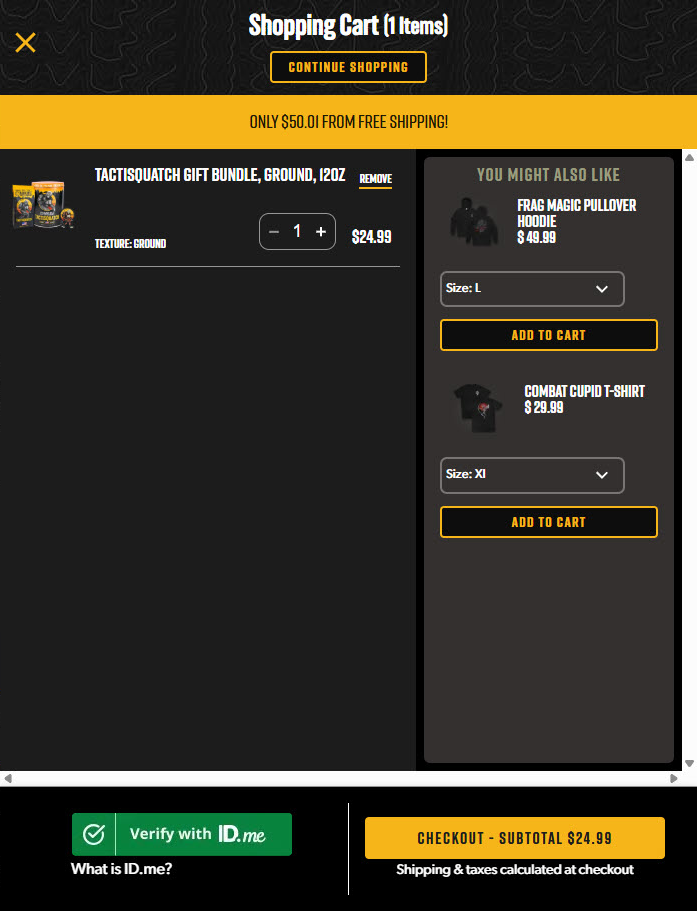
Top stores work hard on order size. Of the 25 top stores we broke down page by page, 22 suggest an upsell or cross-sell before checkout, and 19 do it right in the cart. Black Rifle Coffee does both in the same cart drawer:
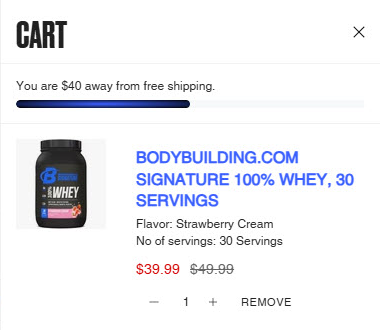
A free shipping goal works the same way. Bodybuilding.com shows a progress bar in the cart, one of only 2 of the 25 stores that do:
Set the threshold with care, because free shipping moves your costs too. Our guide on how to set your free shipping threshold walks through the math.
A higher conversion rate raises the ROAS you get
To be precise: conversion rate doesn't change the break-even line itself. That's set by your margin. What it changes is the ROAS you actually get. You pay for clicks, so when more of those clicks buy, the same ad spend brings in more sales.
| Conversion rate | Orders per 1,000 clicks | ROAS you get | Profit after ads |
|---|---|---|---|
| 1.5% | 15 | 1.5 | −$125 |
| 2.0% | 20 | 2.0 | $0 |
| 2.5% | 25 | 2.5 | +$125 |
| 3.0% | 30 | 3.0 | +$250 |
Our worked example, not test results. 1,000 clicks at $0.50 each ($500 in ads), a $50 average order and $25 profit per order before ads.
Going from 2% to 2.5% turns a campaign that only breaks even into one that makes $125 on every $500 you spend. Put both levers together, a 2.5% conversion rate and a $60 order, and the same 1,000 clicks return a ROAS of 3.0 against a break-even of 1.90, for $290 of profit instead of $0.
Both levers meet in one number: revenue per visitor, which is conversion rate × average order value. Multiply it by your margin before ads and you get the most you can afford to pay per click. Raise revenue per visitor and every ad you run has more room.
Most store owners try to fix a bad ROAS inside the ad account. But the ad's only job is to bring someone to your store. If the page they land on doesn't sell, no audience or bid will fix that.
5 ways to lower your break-even ROAS
- Raise your average order value. Add a relevant add-on in the cart, offer bundles and set a free shipping goal a little above your average order. Our guide on how to increase average order value covers 7 ways, and bundle pricing shows how to price bundles so they don't eat your margin.
- Discount less. Every sitewide code comes straight out of your margin and pushes your break-even ROAS up. Read when discounts hurt before your next sale.
- Cut costs per order. Renegotiate shipping, use lighter packaging, and check which apps take a cut of every sale.
- Fix the pages your ads land on. Many ads send clicks straight to a product page, so start there. Our product page optimization guide and our list of ways to increase your Shopify conversion rate show what to check first.
- Test, and judge by revenue per visitor. A change that lifts orders but shrinks the average order can leave you worse off. Revenue per visitor catches both. Our guide to ecommerce A/B testing shows how.
This is the work we do every day at FunnelSpark, an ecommerce CRO agency for Shopify stores. Of the 1,000+ A/B tests we've run, 37% beat the original, against an industry average of about 15%. Not sure where your store leaks? Our free Leak Finder walks you through 20 checks from homepage to checkout.
FAQ
Divide 1 by your profit margin before ad spend. Or divide your average order value by your profit per order after product cost, shipping and fees. A $50 order with $25 left over has a break-even ROAS of 2.0.
A lower one, because it means each order leaves more profit to pay for ads. Stores with a 50% margin before ads break even at 2.0. Stores with a 25% margin need 4.0. A good ROAS is one comfortably above your own break-even.
No. Break-even ROAS is the floor where ads make zero profit. Target ROAS is the goal you set in Google Ads or Meta, usually above break-even, so there's room for fixed costs and profit.
Blended ROAS, or MER (marketing efficiency ratio), is your total revenue divided by your total marketing spend. It shows whether all your marketing together makes money, without relying on each ad platform's own reporting.
Not directly. Break-even ROAS is set by your margin. A higher conversion rate raises the ROAS you actually get from the same ad spend, so you clear break-even more easily. A higher average order value does lower the break-even number itself.
Written by
Nicolas Fradet
Nicolas is the founder of FunnelSpark, an ecommerce CRO agency. He has spent 16 years finding out why shoppers don't buy, with 1,000+ A/B tests run and a 37% win rate. He wrote Stop Guessing. Start Converting.
Follow Nicolas on LinkedIn →Want us to find what's stopping your shoppers?
On a free 30-minute call, Nicolas looks at your store and shows you 3 growth opportunities, whether we work together or not.
Book your free call