Satisfaction guarantee examples that lift conversion (and how to word yours)
The 5 kinds of guarantee, what top stores actually show, a wording formula, where to put it, and the math that tells you whether yours pays for itself.

By Nicolas Fradet, founder of FunnelSpark · 16 years in CRO, 1,000+ A/B tests
Updated Nov 24, 2026 · 10 min read
The short answer
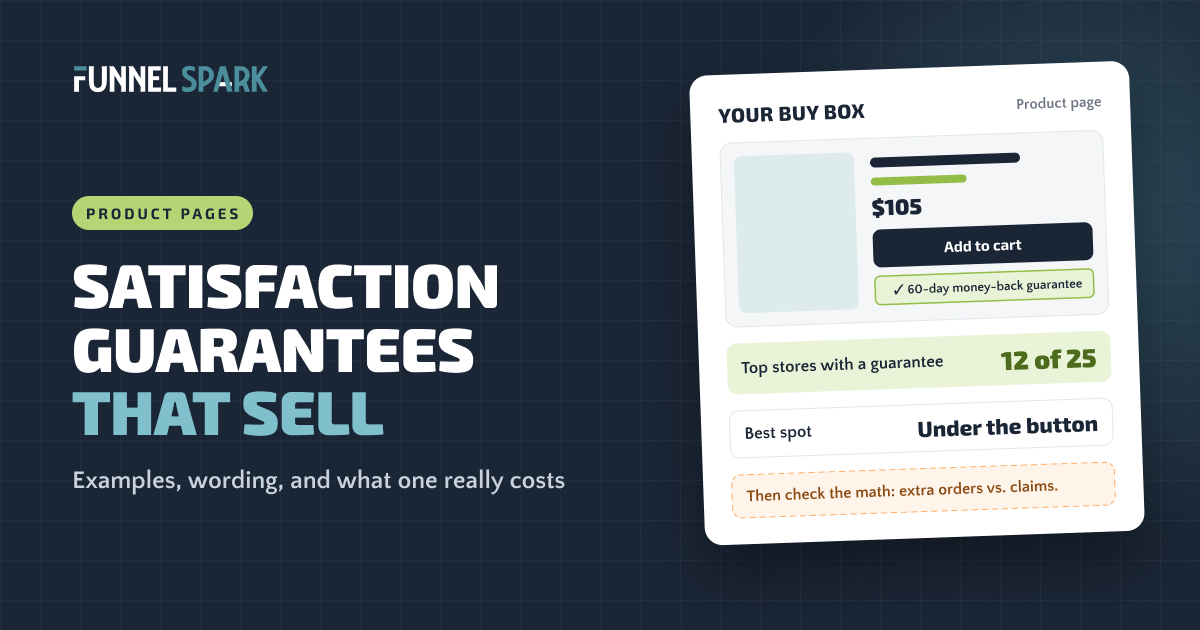
A satisfaction guarantee lifts conversion when it answers the exact worry that stops your shoppers, in 1 specific line under the add to cart button. "60-day money-back guarantee, free return label" beats "Satisfaction guaranteed." Then check the math: the extra orders must outweigh the extra claims, so judge it on profit per visitor.
What is a satisfaction guarantee?
A satisfaction guarantee is a promise that a customer who isn't happy with a product can get their money back, a replacement or a fix. It moves the risk of a bad purchase from the shopper to you. That's why marketers call it risk reversal.
In the US, the words carry a specific meaning. The FTC's guides on advertising guarantees (16 CFR 239.3) say terms like "Satisfaction Guarantee" and "Money Back Guarantee" should only be used if the seller refunds the full purchase price when the buyer asks, and that any material limits or conditions must be disclosed clearly and prominently. So if your "guarantee" means "store credit, unopened items only," you need to say so. This isn't legal advice: have your lawyer read the final wording.
Does a satisfaction guarantee increase sales?
Usually, yes, as long as it's specific and visible. Shoppers who can't touch the product are weighing one question: what if I don't like it? In Baymard Institute's checkout research, 13% of US shoppers who abandoned an order said the returns policy wasn't satisfactory.
The research on returns points the same way. A meta-analysis of 21 papers published in the Journal of Retailing (summarized by UT Dallas) found that lenient return policies increased purchases. Leniency also nudged returns up, but not every kind: longer return windows actually reduced returns, while widening what could be returned (like sale items) increased them.
What nobody can give you is a universal lift number. A guarantee on a $40 serum that "might not work for my skin" does far more than one on a phone cable. So do the math and test it on your store.
5 types of guarantee, and which fits your store
Pick the guarantee that answers your shoppers' biggest worry. Your reviews, support tickets and post-purchase surveys usually make it obvious.
| Type | What it promises | Best for | Watch out for |
|---|---|---|---|
| Money-back | A full refund within X days if they're not happy | Skincare, supplements, anything where the worry is "will it work for me?" | Claims on used products you can't resell. Model the cost first. |
| Free trial | Use it for X days, send it back if it's not right | Shoes, mattresses, gear people have to use to judge | Return shipping and refurbishing costs |
| Price | You won't find it cheaper, or we'll match it | Products also sold by other retailers and marketplaces | You must honor it, every time, with clear rules |
| Quality or lifetime | We'll repair or replace it if it fails | Bags, outerwear, tools, durable goods | Claims arrive for years. Replace or repair, don't refund. |
| Returns promise | Free or easy returns and exchanges | Apparel and anything with a fit or size worry | Scope creep (sale items, worn items) raises return rates |
You can combine 2, but lead with the one that answers the main worry. Three promises in a row read like fine print.
Satisfaction guarantee examples from top stores
We broke down 25 top online stores page by page, from homepage to checkout. Here's how many lean on a guarantee:
top stores make a guarantee or returns promise somewhere in the funnel. Most show it on the product page, and only a few repeat it at checkout, like Chewy, Venus et Fleur and Blueland. Source: the 25 top stores FunnelSpark broke down page by page.
The 12 are SKIMS, Hawthorne, Decathlon, Sanrio, Chewy, KEEN, Frank & Oak, Bodybuilding.com, Venus et Fleur, Blackstone, Blueland and Cambridge Satchel. Most of them make it a returns promise. Only a few make a real guarantee, and those are the examples worth copying.
Blueland: money-back guarantee right under the button
Blueland sells refillable cleaning products, so the worry is "will this actually clean as well as what I use now?" Its answer sits in the one spot every buyer looks at:
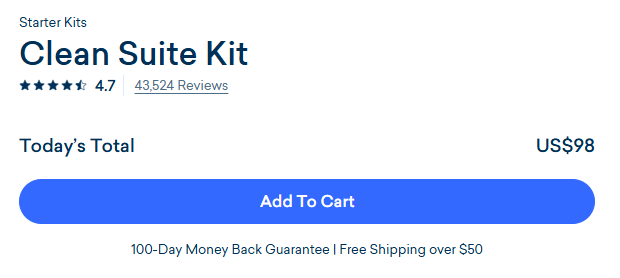
No badge, no shield icon, no popup. One line of text, with a number in it, next to the button. Blueland repeats its promises (including 100-day hassle-free returns) in its checkout order summary too.
Bodybuilding.com: a price promise on the product page
Protein powder is sold everywhere, so the worry isn't quality. It's "could I get this cheaper somewhere else?" Bodybuilding.com answers that one instead:
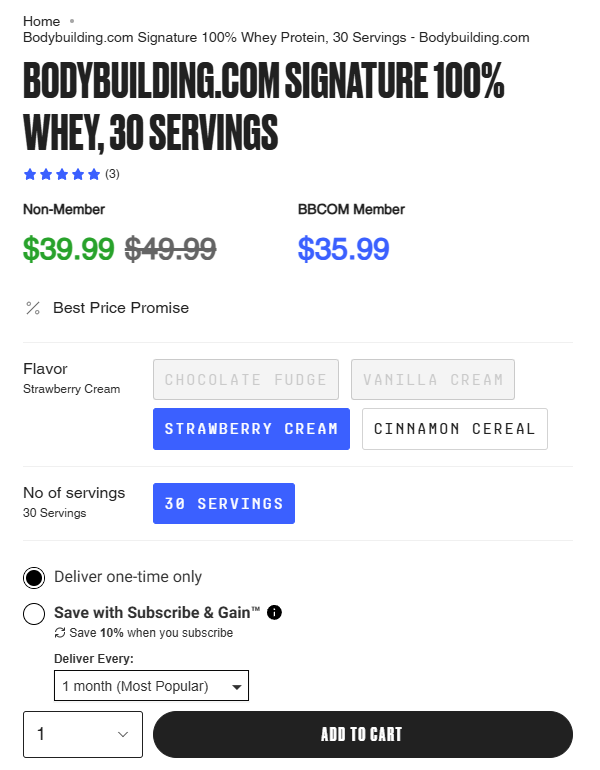
Chewy: risk reversal at checkout
Chewy repeats its promises at checkout, when doubts peak, and lists them next to the order total:
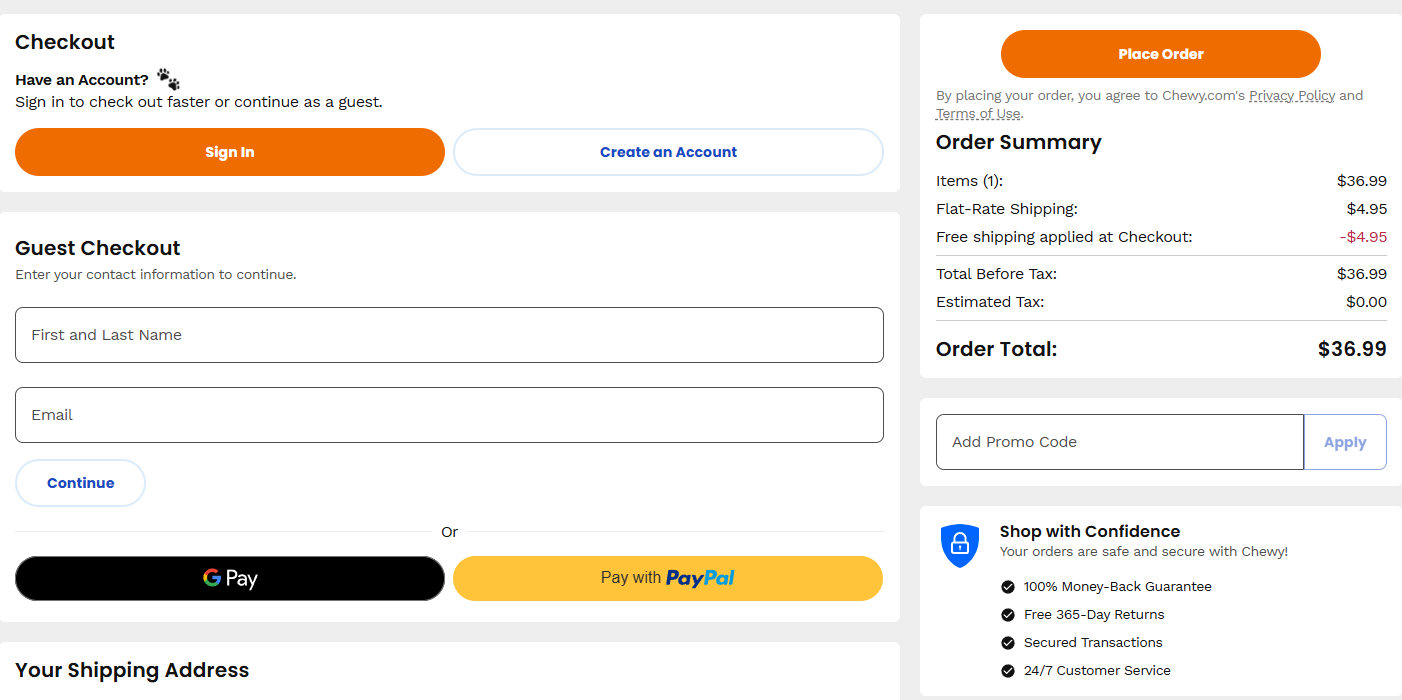
A few more worth knowing: KEEN shows a "30-Day Trial" note right above its Add to bag button, which answers "what if they hurt after a week?" Hawthorne makes a quality promise on its product pages. Venus et Fleur shows its guarantee at checkout, right next to its order bumps, so the add-ons feel as safe as the main purchase.
How to word your guarantee
"Satisfaction guaranteed" is so common that shoppers skim past it, and it makes them guess: for how long? Who pays shipping? A good guarantee answers that in 1 line. Use this formula:
The guarantee formula
Time (how long they have) + Trigger (what counts: "if you don't love it") + Remedy (full refund, replacement, repair) + Effort (how easy: "free return label," "no need to send it back").
Here's how that changes a few common lines. These are our own examples, not from a specific store:
| Before | After | Why it's better |
|---|---|---|
| Satisfaction guaranteed | Love it in 60 days or get a full refund. Free return label. | Says how long, what they get and that returns cost nothing |
| Easy returns | Wrong size? Free exchanges for 30 days, even if you wore it once. | Names the real worry (fit) and removes the "worn it once" fear |
| 100% money-back guarantee* | Try 2 bottles. If it doesn't work for you, email us and we'll refund both. | No asterisk. The condition is written in plain words. |
| Lifetime warranty | If a seam or zip ever fails, we'll repair or replace it for free. | Concrete about what's covered |
3 more rules. Write the conditions in plain words next to the promise, not behind an asterisk (that's also what the FTC guidance asks for). Make your returns policy page say exactly the same thing. And give it a name if you like ("The 60-day promise"), but only after the line itself is clear. More on writing lines like this in our ecommerce copywriting guide.
Where should you show your guarantee?
Show it where the doubt happens. For most stores, that's the moment a shopper's thumb is over the add to cart button, so start there. Then repeat a shorter version further down the funnel.
Where to show your guarantee, step by step
Seen at: Frank & Oak, Cambridge Satchel
Plants the idea early. Keep it to 5 or 6 words.
Nice to have
Seen at: Blueland, KEEN
The full promise, where the buying decision happens.
Start here
Seen at: Cambridge Satchel (returns copy)
Reassures right before the shopper commits to checkout.
Any plan
Seen at: Chewy, Venus et Fleur, Blueland
Custom text here needs Shopify Plus.
Shopify Plus only
A Shopify Plus note. Shopify's checkout is one page by default, and adding your own text inside the checkout steps (like a guarantee line near the pay button) needs Shopify Plus and checkout extensibility. Our guide to Shopify checkout extensibility covers how. On any plan, the product page and cart are yours to edit, and Shopify's help center confirms the policies you add are linked in the checkout footer automatically. So make sure your refund policy matches the promise.
What about a guarantee badge? A round "100% satisfaction guaranteed" seal says less than a line of text and looks the same on every store. Only 8 of the 25 top stores we broke down show trust-type badges or logos at all. If your theme uses one, keep it, but put the specific line next to it. We dig into this in do trust badges work?
A guarantee also works best next to proof. Stars and a review count above the button, a guarantee under it: that's the pairing on Blueland's page. If your review counts are thin, start with how to get more product reviews, and for the bigger picture see how to build trust with customers online.
What does a satisfaction guarantee cost? The math for a $1.5M store
The fear is always the same: "people will abuse it." Some will. The question is whether the extra orders pay for the extra claims. Let's run it for a mid-size store:
- 60,000 sessions a month, 2% conversion, $105 average order: 1,200 orders and $126,000 a month (about $1.5M a year), or $2.10 revenue per visitor.
- Product cost of 40% ($42) plus $12 shipping and handling: each order leaves $51.
- Worst case for a claim: you refund the $105 and can't resell the product. You lose the $54 you spent on it.
- Today: 1,200 × $51 = $61,200 profit a month, or $1.02 per visitor.
"Extra claims" below means claims on top of the returns you already get, as a share of all orders. Each claim swings that order from +$51 to −$54.
Monthly profit change after adding a guarantee (our example store)
| Conversion lift | 1% extra claims | 2% extra claims | 3% extra claims |
|---|---|---|---|
| +3% (1,236 orders) | +$538 | −$760 | −$2,057 |
| +5% (1,260 orders) | +$1,737 | +$414 | −$909 |
| +10% (1,320 orders) | +$4,734 | +$3,348 | +$1,962 |
Profit = orders × ($51 − $105 × claim rate). Break-even extra claim rate: about 1.4% for a 3% lift, 2.3% for a 5% lift and 4.4% for a 10% lift. Our model, not data from a client.
Look at the +5% lift with 3% extra claims. Revenue per visitor after refunds goes up, from $2.10 to about $2.14. Profit goes down by about $900 a month. That's why we judge a guarantee on profit per visitor, not conversion rate alone. (More on why in revenue per visitor.)
3 ways to tilt the math your way:
- Offer a remedy that costs less than a refund. Exchanges, replacements and repairs keep the revenue. A refund is the last resort, not the headline, unless the worry is "will it work?"
- Use a longer window, not a wider scope. The meta-analysis above found longer return windows reduced returns, while widening what can be returned increased them.
- Make products resellable. If returned items can go back on the shelf, a claim costs you shipping and handling, not $54.
How to test a guarantee
A guarantee is a great A/B test because it's a big, visible change that costs almost nothing to build. Here's how we'd run it:
- Change only the line, not the policy. Most stores already accept returns. Test showing a clear guarantee line under the button against your current page, on your product page template so every product gets it.
- Check your traffic. At a 2% conversion rate, spotting a 10% lift takes about 81,000 visitors per version. For our example store, that's about 12 weeks with every session in the test, which is too long. A 15% lift takes about 5 weeks. So test a bold, specific line, and use add to cart rate as an early signal. Our guide to ecommerce A/B testing has the full traffic table.
- Measure revenue per visitor and claims. Most testing tools report revenue per visitor. Tag the orders by version so you can match refunds and claims back to them later.
- Wait out the window. A 60-day guarantee test isn't finished when the test ends. Count claims for 60 days after the last order, then compute profit per visitor for each version with the formula above.
- Brief your developer once. The line, its spot (directly under the add to cart button, on mobile too), a link to the full policy, and matching copy on the policy page.
At FunnelSpark, an ecommerce CRO agency for Shopify stores, we've run 1,000+ A/B tests, and the changes that win most often answer a worry the shopper already had. A clear guarantee is one of the cheapest ways to do that. Just measure the claims, not only the orders.
Doing $100k+ a year, or running ecommerce in-house? Book a free 30-minute call and we'll look at where your guarantee, and the rest of your buy box, could be costing you sales.
FAQ
It means a customer who isn't happy can get their money back. Under the FTC's guides on advertising guarantees (16 CFR 239.3), terms like "Satisfaction Guarantee" and "Money Back Guarantee" should only be used if the seller refunds the full purchase price at the buyer's request, with any conditions disclosed clearly. It isn't legal advice, so check your wording with a lawyer.
Usually, when it's specific and shown near the add to cart button. A meta-analysis of 21 papers in the Journal of Retailing found lenient return policies increased purchases. How much depends on your product and your shoppers' main worry, so test it and judge it on profit per visitor, not conversion rate alone.
A returns policy explains the rules for sending something back. A satisfaction guarantee is a promise about the outcome: if you're not happy, you get your money back (or a replacement or repair). Many stores have a good returns policy and never say it as a promise. Turning it into 1 clear line is often the easiest win.
Long enough to remove the worry: 30 days for most products, 60 to 100 days for things that take time to judge, like skincare or bedding. A meta-analysis summarized by UT Dallas found that longer return windows actually reduced returns, while widening what can be returned increased them.
Adding your own text inside the Shopify checkout steps needs Shopify Plus. On any plan, you can show the guarantee on the product page and in the cart, and the refund policy you add in Shopify is linked in the checkout footer automatically.
Written by
Nicolas Fradet
Nicolas is the founder of FunnelSpark, an ecommerce CRO agency. He has spent 16 years finding out why shoppers don't buy, with 1,000+ A/B tests run and a 37% win rate. He wrote Stop Guessing. Start Converting.
Follow Nicolas on LinkedIn →Want us to find what's stopping your shoppers?
On a free 30-minute call, Nicolas looks at your store and shows you 3 growth opportunities, whether we work together or not.
Book your free call