How to increase customer lifetime value in ecommerce
What customer lifetime value is, how to calculate it with a simple formula, and 7 ways to get customers to come back and buy again.

By Nicolas Fradet, founder of FunnelSpark · 16 years in CRO, 1,000+ A/B tests
Updated Nov 1, 2026 · 8 min read
The short answer
Customer lifetime value (CLV) is what a customer spends with you across every order they ever place. To raise it, make the first order easy to love, follow up with helpful emails, remind people when it's time to reorder, offer subscriptions or rewards, and raise order value. Small gains on each lever multiply.
What is customer lifetime value?
Customer lifetime value (CLV, sometimes called LTV) is the total a customer spends with your store over the whole time they buy from you. Not just the first order. Every order after it, too.
Most stores look at the first sale only. They see an ad that costs $40 to win a customer who spends $60, and they panic. But if that customer comes back 2 more times, the math looks very different. CLV is the number that tells you which story is true.
It also explains why repeat customers matter so much. Research by Frederick Reichheld of Bain & Company, cited by Harvard Business Review, found that raising customer retention rates by 5% increases profits by 25% to 95%. The same HBR article notes that winning a new customer costs anywhere from 5 to 25 times more than keeping an existing one, depending on the study and the industry.
Most stores put all their energy into the first sale, then go quiet. The cheapest order you'll ever get is the second one, from someone who already likes what they bought. Make the first order easy to love, then give them a reason to come back.
How do you calculate customer lifetime value?
There are fancy models with churn curves and discount rates. You don't need them to make good decisions. This simple version works for most stores:
The simple CLV formula
CLV = average order value × orders per customer per year × years a customer keeps buying
For a profit view, multiply by your gross margin (what you keep after product costs). Profit CLV is the number to compare with what you pay to win a customer.
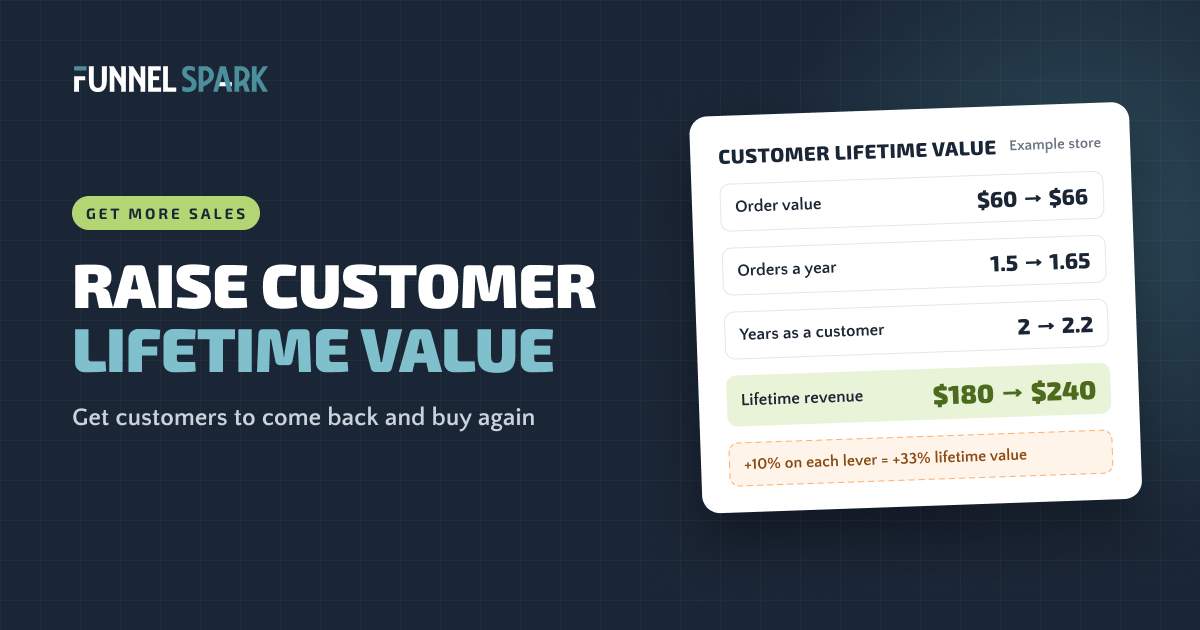
Here's a worked example with made-up numbers (not client data). A store has a $60 average order value. Its customers place 1.5 orders a year and keep buying for 2 years. Its gross margin is 50%.
Worked example: one lever at a time
| Scenario | Order value × orders a year × years | Lifetime revenue | Lifetime profit (50%) |
|---|---|---|---|
| Today | $60 × 1.5 × 2 | $180 | $90 |
| Order value +10% | $66 × 1.5 × 2 | $198 | $99 |
| Orders a year +10% | $60 × 1.65 × 2 | $198 | $99 |
| Years +10% | $60 × 1.5 × 2.2 | $198 | $99 |
| All 3 +10% | $66 × 1.65 × 2.2 | $239.58 | $119.79 |
Our example, calculated with the formula above. Each lever alone adds 10%. All 3 together add 33%, because they multiply.
That last row is the whole idea of this article. You don't need one giant win. A 10% bump on each lever turns $180 into about $240 per customer.
Why small gains on each lever add up
Order value
$60 today
$66
+10%Orders a year
1.5 today
1.65
+10%Years buying
2 today
2.2
+10%Lifetime revenue
$180 today
$240
+33%Where to find your numbers on Shopify
Take the last 12 months. Average order value is revenue divided by orders. Orders per customer per year is orders divided by the number of customers who bought. For years, start with an honest guess, then check it against your data as it grows.
Shopify's built-in customer reports help here. The Returning customers report lists everyone with more than one order. The Customer cohort analysis groups customers by the month of their first order and tracks their repeat purchases over time. The RFM customer analysis scores customers on recency, frequency and money spent, so you can see who your best buyers are.
Why a higher CLV lets you spend more on ads
Go back to the example. The first $60 order leaves $30 of profit. If an ad costs $40 to win that customer, you lose $10 on day one. Many store owners would turn that ad off.
But over 2 years, that customer brings $90 of profit. After the $40 ad cost, you're up $50. Raise lifetime profit to about $120 and you could pay $60 for a customer and still come out $60 ahead, or keep paying $40 and pocket the difference.
That's the real power of CLV. The store that earns more from each customer can outbid its competitors for the same ads. Two cautions, though. Profit that arrives in year 2 doesn't pay this month's bills, so check how long it takes to earn back what you paid. And base your numbers on what customers actually do, not what you hope they'll do.
How to increase customer lifetime value: 7 ways
These are ordered roughly the way a customer meets them: first order, the weeks after, and the months after that.
1. Make the first order easy to love
Few people come back after a bad first order. The product has to match what the page promised, arrive when you said it would, and be easy to return if it doesn't work out. Most repeat-purchase problems start on the product page: unclear sizing, vague photos or a missing answer that leads to a return. Our product page optimization guide covers the fixes, and our FAQ page examples show how to answer worries before the sale instead of after it.
2. Send post-purchase emails that help
The weeks after the first order are when people decide if they like you. Use them to help, not to sell. A good sequence:
- Order and shipping updates that are clear and on time. Fewer "where's my order?" worries.
- A how-to-use email when the order lands: tips, care, the one mistake to avoid. People who get results buy again.
- A review request once they've had time to use it.
- A "what goes with it" email that suggests one product that fits what they bought.
Write them like a person, not a brand. Our ecommerce copywriting guide shows how.
3. Remind people before they run out
If you sell something people use up (coffee, supplements, skincare, pet food), time a reminder to when they'll need more. Look at how many days usually pass between a customer's first and second order, and send the reminder a few days before that. Link straight to the product they bought, so reordering takes 2 clicks, not a search.
4. Offer subscribe and save
A subscription turns "I should reorder" into an order that happens on its own. Of the 25 top stores we broke down page by page, we flagged a subscribe and save option on only 1: Bodybuilding.com. For stores that sell repeat-use products, that's a gap worth testing. On Shopify, the free Shopify Subscriptions app (made by Shopify) supports subscribe and save pricing and lets customers skip, pause or cancel.
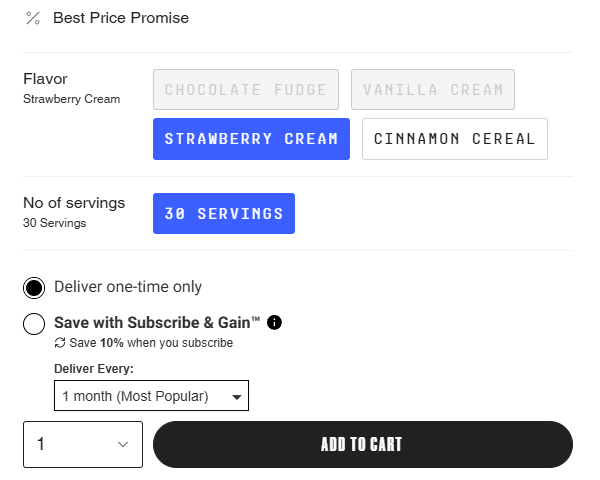
Make the subscription feel safe. Say clearly that people can skip or cancel any time. A subscription people feel trapped in brings angry emails and chargebacks, not lifetime value.
5. Reward repeat customers
Loyalty programs are less common than you'd think. Only 3 of the 25 top stores we broke down promote a loyalty or rewards program: SKIMS at checkout, Gymshark on the product page and Kylie Cosmetics in the cart. The best ones show shoppers what they earn on this order, while they're deciding.
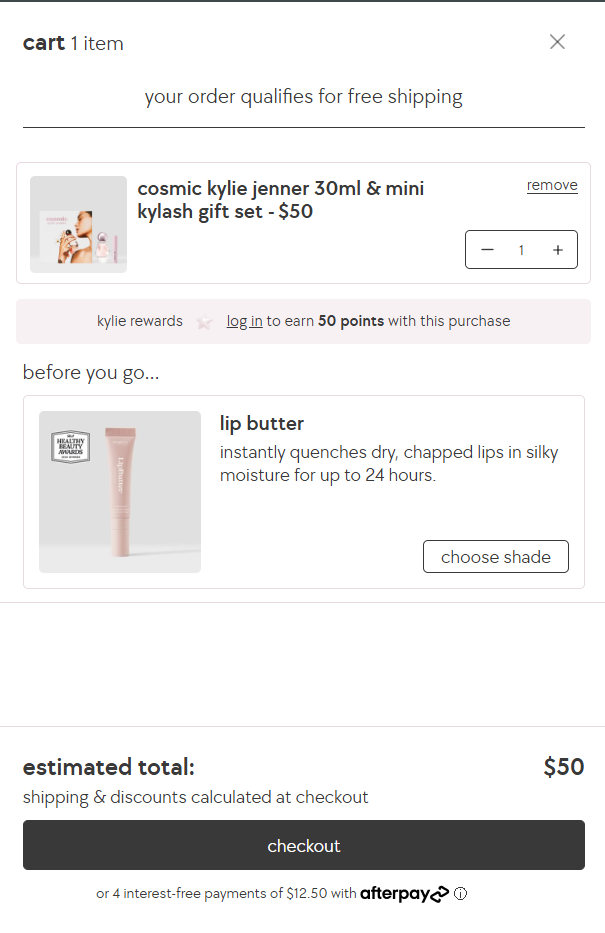
On Shopify, adding custom content inside the checkout steps needs Shopify Plus, so most stores show rewards on the product page or in the cart instead. And keep the program simple. "Earn 50 points on this order" is clear. A points table with 4 tiers and expiry rules isn't.
6. Raise the value of every order
Order value is one of the 3 levers, and it works on first orders and repeat orders alike. 22 of the 25 top stores we broke down suggest an extra product before checkout. A free shipping threshold set just above your average order is another easy one. Judge every change by revenue per visitor, so a bigger cart doesn't hide fewer orders.
7. Win back customers who drift away
Some customers just forget you. When someone goes well past their usual time between orders, send a short "we miss you" email that shows what's new or reminds them what they liked. Shopify's RFM customer analysis is a good place to find them: high spenders whose recency score is slipping. Try a helpful message before you reach for a discount. If every win-back email has a coupon, customers learn to wait for it.
How to tell if it's working
CLV moves slowly, so don't wait 2 years to find out. Track faster signals:
- Repeat rate within 90 days. Of the customers who placed a first order in a given month, how many bought again within 90 days? The cohort report shows this month by month.
- Days between first and second order. If reminders and emails work, this gets shorter.
- Revenue per visitor. For anything on your site, like a subscribe option or a rewards message, A/B test it when your traffic allows and judge it by revenue per visitor.
- Profit, not just revenue. Discounts can buy repeat orders that lose money. Check what each repeat order leaves after the discount.
One last thing: CLV can't fix a store that doesn't convert. If shoppers aren't buying the first time, start there. Our guide to traffic but no sales shows where to look, and FunnelSpark, an ecommerce CRO agency for Shopify stores, can find your biggest leak with you on a free call.
FAQ
Multiply your average order value by the number of orders a customer places per year, then by the number of years they keep buying. For example, $60 × 1.5 orders a year × 2 years = $180. Multiply by your gross margin to get lifetime profit.
There's no single good number. What matters is how lifetime profit compares with what you pay to win a customer. If a customer brings $90 of profit and costs $40 to acquire, you have room to grow. If they cost more than they bring, fix that first.
Average order value is what a customer spends in one order. Customer lifetime value is what they spend across all their orders. Raising average order value raises lifetime value, but so do more orders per year and more years as a customer.
Make the first order a good experience, send helpful emails after delivery, remind customers when it's time to reorder, and make reordering quick. Subscribe and save and simple rewards help for products people use up. Try a helpful message before you offer a discount.
They can, mostly for products people buy often. Only 3 of the 25 top stores we broke down promote one. Keep it simple, show what the shopper earns on this order, and test it against no program to see if it adds profit, not just points.
Written by
Nicolas Fradet
Nicolas is the founder of FunnelSpark, an ecommerce CRO agency. He has spent 16 years finding out why shoppers don't buy, with 1,000+ A/B tests run and a 37% win rate. He wrote Stop Guessing. Start Converting.
Follow Nicolas on LinkedIn →Want us to find what's stopping your shoppers?
On a free 30-minute call, Nicolas looks at your store and shows you 3 growth opportunities, whether we work together or not.
Book your free call