Negative reviews can increase sales: how to respond to bad reviews
Why a perfect 5.0 can cost you sales, how to reply to a 1-star review on your product page, and how to turn the complaints into page fixes you can test.

By Nicolas Fradet, founder of FunnelSpark · 16 years in CRO, 1,000+ A/B tests
Updated Nov 27, 2026 · 9 min read
The short answer
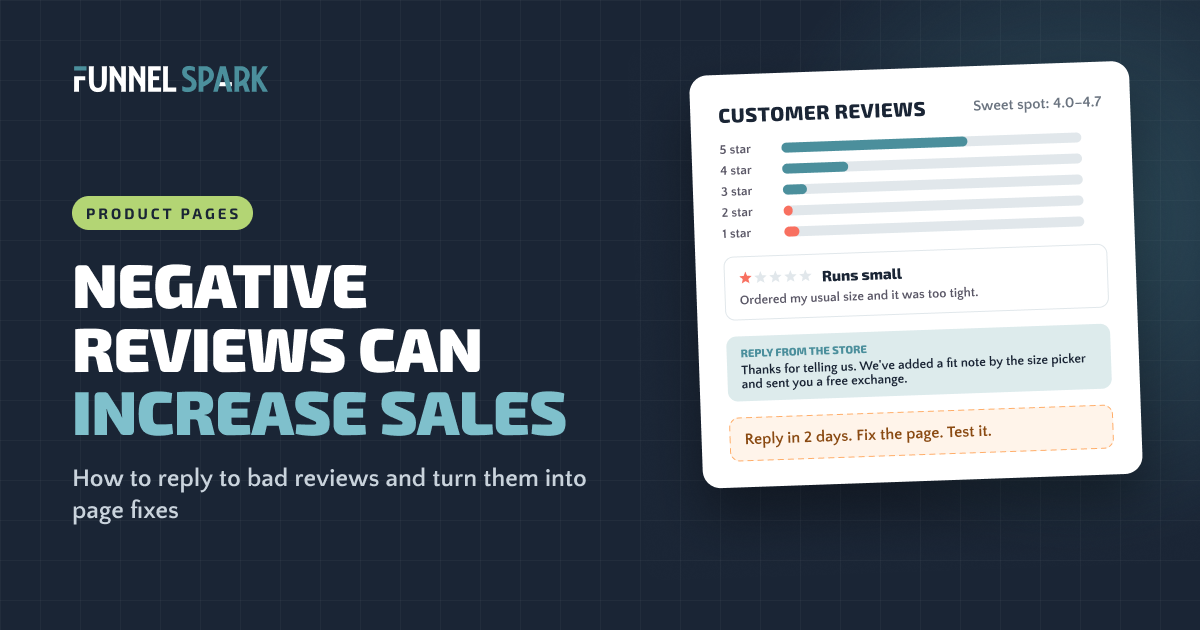
Yes, negative reviews can help you sell. Shoppers trust a 4.0 to 4.7 average more than a perfect 5.0, and most of them go looking for the bad reviews. Keep them up, reply to every 1 to 3 star review within 2 business days, and turn repeat complaints into product page changes you test on revenue per visitor.
Can negative reviews really increase sales?
A negative review is any review that rates a product low, usually 1 to 3 stars, or that complains about the product, the delivery or the service. On their own they don't sell anything. But a review section with a few of them sells better than one without any, because it looks real.
The research backs this up. The Spiegel Research Center at Northwestern University found that negative reviews "can have a positive impact because they establish credibility and authenticity." In a PowerReviews survey of 6,538 US shoppers, 96% said they look for negative reviews at least sometimes, and 52% look for 1-star reviews in particular. And in Baymard Institute's usability testing, 53% of users went looking for the negative reviews of a product.
So shoppers will read your bad reviews whatever you do. The question is what they find there: a fair complaint with a helpful reply, or silence.
top stores we broke down show ratings and reviews on the product page. 14 of them also put star ratings on collection pages. When almost every big brand shows reviews, shoppers expect to see them, bad ones included. Source: FunnelSpark's page-by-page breakdown of 25 top online stores.
Why do perfect 5-star reviews look fake?
Because real products have real flaws. Nobody believes that 100% of buyers loved anything. The Spiegel Research Center found that purchase likelihood "typically peaks at ratings in the 4.0 – 4.7 range" and then drops as ratings get closer to 5.0. PowerReviews found that 46% of shoppers are suspicious of a product with a perfect 5 out of 5 average.
What your average rating tells shoppers
| Average rating | What shoppers tend to think |
|---|---|
| Below 4.0 | "Something's wrong with it" |
| 4.0 to 4.7 | "Good product, honest reviews" |
| 4.8 to 5.0 with few or no low ratings | "Too good to be true" |
The 4.0 to 4.7 sweet spot comes from the Spiegel Research Center. The labels are our plain-English summary.
3 things make your reviews more believable, without touching a single star:
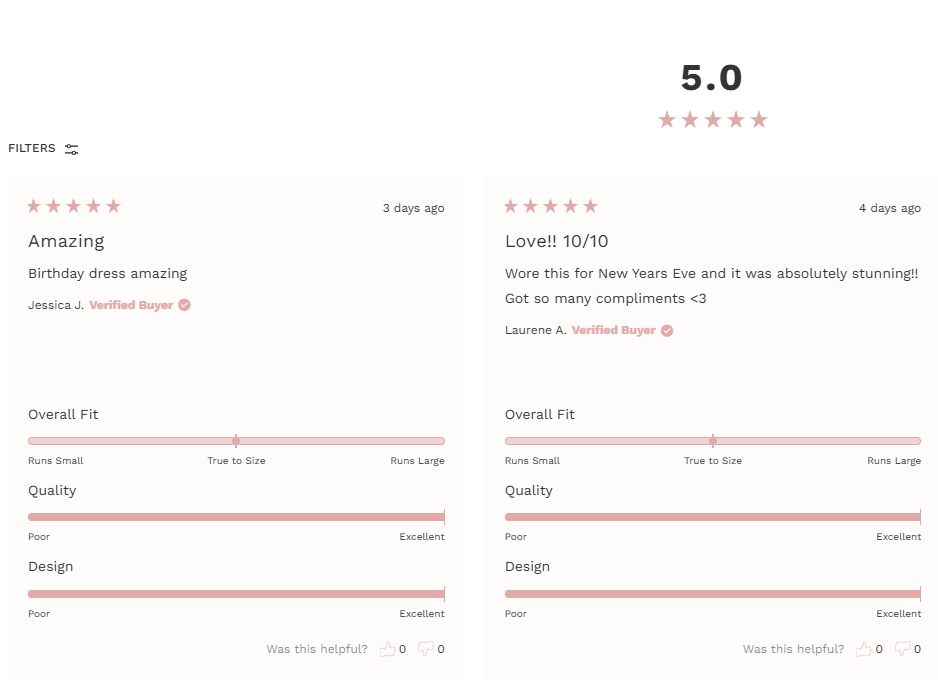
- Show the rating breakdown. A bar for each star level lets shoppers see that the 1-star reviews exist and how few there are. Baymard found that 43% of the 60 top-grossing ecommerce sites it studied don't show one, and that users lean on that breakdown even more than on the reviews themselves.
- Mark verified buyers. The Spiegel Research Center found that "verified buyer" badges improve the odds of purchase by 15%. Check your reviews app's settings: the tag is often a switch you can turn on.
- Ask about the big worry. A sub-rating for fit, taste or ease of use turns a vague complaint into a useful answer for the next shopper.
What is one repeat complaint worth?
The money isn't in any single bad review. It's in the complaint that keeps coming back: every shopper who reads it has the same doubt, and every buyer who ignores it may send the product back.
Here's an example. Take a $1.5M-a-year store with 60,000 sessions a month, a 2% conversion rate and a $105 average order. Its best seller's page gets 12,000 sessions a month, and "runs small" shows up again and again in its 2 and 3 star reviews. Say 12% of that product's orders come back for size. The store adds a clear fit note next to the size picker and a line in the size guide, and the page converts 5% better (2.0% to 2.1%) while size returns drop to 10%.
One product page, before and after answering the complaint
| Per month | Before | After |
|---|---|---|
| Sessions on the page | 12,000 | 12,000 |
| Conversion rate | 2.0% | 2.1% |
| Orders | 240 | 252 |
| Revenue ($105 average order) | $25,200 | $26,460 |
| Returned for size | 12% (28.8 orders) | 10% (25.2 orders) |
| Revenue kept after returns | $22,176 | $23,814 |
| Kept revenue per visitor | $1.85 | $1.98 |
Example numbers, not a test result. The math: 12,000 × 2.1% = 252 orders × $105 = $26,460, minus 10% returns = $23,814. That's $1,638 more a month, or about $19,700 a year, from 1 page and 1 complaint.
Notice that the gain shows up in 2 places: more orders and fewer refunds. That's why we judge these changes on revenue per visitor, after returns where you can, and not on conversion rate alone.
How to respond to negative reviews (with templates)
Most stores don't reply at all. Baymard found that 87% of ecommerce sites don't respond to negative reviews, even on their most popular products, while 37% of users take a site's reply into account when they judge the review, the product and the store. A short, calm reply is one of the cheapest trust signals you have.
Replies also change the reviews that come next. In a study of TripAdvisor hotel reviews by Davide Proserpio and Georgios Zervas in the journal Marketing Science (summarized by INFORMS), hotels that started replying got 12% more reviews and their ratings rose by 0.12 stars on average. Negative reviews became less common, but longer and more detailed. Different industry, same trade-off for a store: fewer drive-by complaints, more useful feedback.
Here's how to reply to a bad review:
- Reply within 2 business days. Set a weekly target and give one person the job. A reply weeks later reads like nobody's home.
- Thank them and name the problem. Use their words, so the next shopper sees you read it.
- Own your part, without arguing. No "this has never happened before." You're writing for the next 1,000 readers, not for a win against one customer.
- Say what you did or will do. A replacement, a refund, a change to the page or the product.
- Move the details to email. Order numbers and addresses don't belong in public.
- Ask for an update once it's fixed. Judge.me, for example, has an "Ask customer to update review" option, available on its free plan. Ask once, and never make a refund depend on it.
Templates you can adapt (keep them short, and make each one sound like your brand):
Sizing or "not what I expected"
"Thanks for telling us, Sarah. You're right that this style runs small, and we've now added a fit note next to the size picker so nobody else gets caught out. We've emailed you a free exchange label for the next size up."
Product defect
"We're sorry the zip broke after 2 weeks. That's not the quality we stand behind. A replacement is on its way, and we've sent the photos to our production team to find out what went wrong."
Late or damaged delivery
"Sorry your order took 9 days. That's longer than we promise. We've refunded your shipping and we're looking into what happened with the carrier. Thanks for your patience."
"Didn't work for me"
"Thanks for the honest review. This blend is strong, so it's not for everyone. If you'd like to try our mild blend instead, reply to the email we just sent and we'll swap it for free."
Make your replies look different from customer reviews, with your store name or a "Staff" label. Baymard recommends this so a reply isn't mistaken for another customer's review. If you use Judge.me, its public replies show under the review with your store name, and you can also reply privately by email.
Should you ever delete a negative review?
Not because it's negative. Beyond the sales argument, there's a legal one. The FTC's rule on consumer reviews and testimonials bars a business from suggesting that the reviews on its site show all or most of the reviews it received when some were hidden because of their rating or negative sentiment. It also bans using threats or intimidation to get a negative review removed, and offering anything in return for a review that depends on it being positive (or negative).
What to do instead:
- Write a short moderation policy based on what a review says, never on its stars: for example spam, abuse, someone's personal details, or a review of a different product. Apply it the same way to 5-star and 1-star reviews.
- Don't filter by rating. If your reviews app auto-publishes high ratings and holds low ones for review, publish the held ones too unless they break your content policy.
- Don't "fix" a low average with a discount for 5-star reviews. If you offer a reward for reviews, it has to be for any honest review.
This isn't legal advice. If you sell in the US and aren't sure your setup is clean, run it past your lawyer.
Turn complaints into product page fixes
Your 1 to 3 star reviews are free research. Shoppers are telling you, in their own words, which questions your page didn't answer. Once a quarter, export the last 12 months of low reviews from your reviews app, tag each one by cause, count the tags, and rank them by the revenue of the products they hit. Then route each cause to the right fix:
From bad review to better page
- Step 11 to 3 star review
- Step 2Reply in 2 days
- Step 3Tag the cause
- Step 4Fix the page or product
- Step 5Test and measure
Cause 1Expectation gap
"Runs small." "Smaller than it looks." "Not the color in the photo."
Page fix: fit note by the size picker, a photo with a size reference, true-color images.
Owner: ecommerce team
Cause 2Wrong buyer
"Too strong for me." "Not for beginners."
Page fix: say who it's for and who it isn't, and point to the better match.
Owner: ecommerce team
Cause 3Delivery or service
"Took 2 weeks." "Arrived damaged." "Nobody answered."
Page fix: honest delivery times by the button and in the cart, a clear returns line.
Owner: operations
Cause 4Product problem
"Broke after a month." "Stitching came apart."
Fix: the product first. Don't write copy around a real defect.
Owner: product team
The expectation gap is usually the biggest bucket, and the easiest to fix. Answer the question where the shopper decides: next to the price, the size picker or the add to cart button. If the answer needs more room, put it in a product page FAQ (our FAQ page examples show how to write one) and link to it from the buy box. For more places to answer doubts, see our product page optimization guide.
If shoppers keep complaining about fit, add a fit question to your review form so future reviews answer it for you. Our guide on how to get more product reviews covers timing, photo reviews and where to place them.
How to test it and measure it
Replying to reviews and turning off rating filters don't need a test. The page changes do, because they can backfire: a badly written fit warning can scare off people who would have been fine.
Good tests to run on a high-traffic product page:
- The answer to the top complaint next to the buy button, against no answer.
- A rating breakdown with clickable bars at the top of the review section, against the plain list.
- The most helpful critical review shown beside the most helpful positive one, against positive reviews only.
- Review sort order: most recent or most helpful first, against highest rated first.
- A delivery or returns line in the cart, where shipping complaints show up. Custom text inside Shopify's checkout steps, near the pay button, needs Shopify Plus. On other plans, put it in the cart.
Judge each test on revenue per visitor, and keep watching the product's return rate for at least a month after you ship the winner, because returns land weeks after the order. Your best seller's page needs enough traffic to read a result, so check the sample size table in our ecommerce A/B testing guide before you start.
Track 4 numbers each month for your top 10 products: average rating, share of 1 to 3 star reviews, median time to reply, and return rate. If the same complaint keeps showing up after a fix, the fix didn't work.
This is the work we do every week at FunnelSpark, an ecommerce CRO agency for Shopify stores: find the question that stops shoppers, answer it on the page, and test it. Across 1,000+ A/B tests, 37% of ours have beaten the original page. Reviews are one of the best places to find those questions, and our guide on how to build trust with customers online covers the rest.
If your store does $100k+ a year, or you run ecommerce in-house, book a free 30-minute call. We'll look at your reviews and your numbers and show you the 3 biggest opportunities we see.
FAQ
Not in small numbers. Shoppers trust a mix of ratings more than a perfect score. The Spiegel Research Center found that purchase likelihood peaks at an average rating of 4.0 to 4.7 and drops as ratings get closer to 5.0. What hurts sales is a repeat complaint you never answer.
Reply within 2 business days. Thank the customer, name the problem in their words, own your part without arguing, say what you've done to fix it, and move order details to email. Once it's solved, you can ask them to update the review, but never make a refund depend on it.
No, not for being negative. Hiding reviews because of their rating makes your reviews less believable, and the FTC's rule on consumer reviews bars presenting your reviews as complete when some were hidden for their rating or sentiment. Remove reviews only under a written policy based on content, like spam, abuse or personal details.
Because no real product pleases every buyer. In a PowerReviews survey of 6,538 US shoppers, 46% said they are suspicious of a product with a perfect 5 out of 5 average. A rating breakdown, verified buyer tags and a few honest complaints with replies make reviews more believable.
There's no fixed number. Watch your average rating and the share of 1 to 3 star reviews for each product. If the average drops below 4.0, or one complaint keeps coming back, fix the product or the product page before you spend more on ads for it.
Written by
Nicolas Fradet
Nicolas is the founder of FunnelSpark, an ecommerce CRO agency. He has spent 16 years finding out why shoppers don't buy, with 1,000+ A/B tests run and a 37% win rate. He wrote Stop Guessing. Start Converting.
Follow Nicolas on LinkedIn →Want us to find what's stopping your shoppers?
On a free 30-minute call, Nicolas looks at your store and shows you 3 growth opportunities, whether we work together or not.
Book your free call