Our CRO process, step by step
What happens from the first call to a steady testing program, and how to run a lighter version on your own store.

By Nicolas Fradet, founder of FunnelSpark · 16 years in CRO, 1,000+ A/B tests
Updated Nov 4, 2026 · 9 min read
The short answer
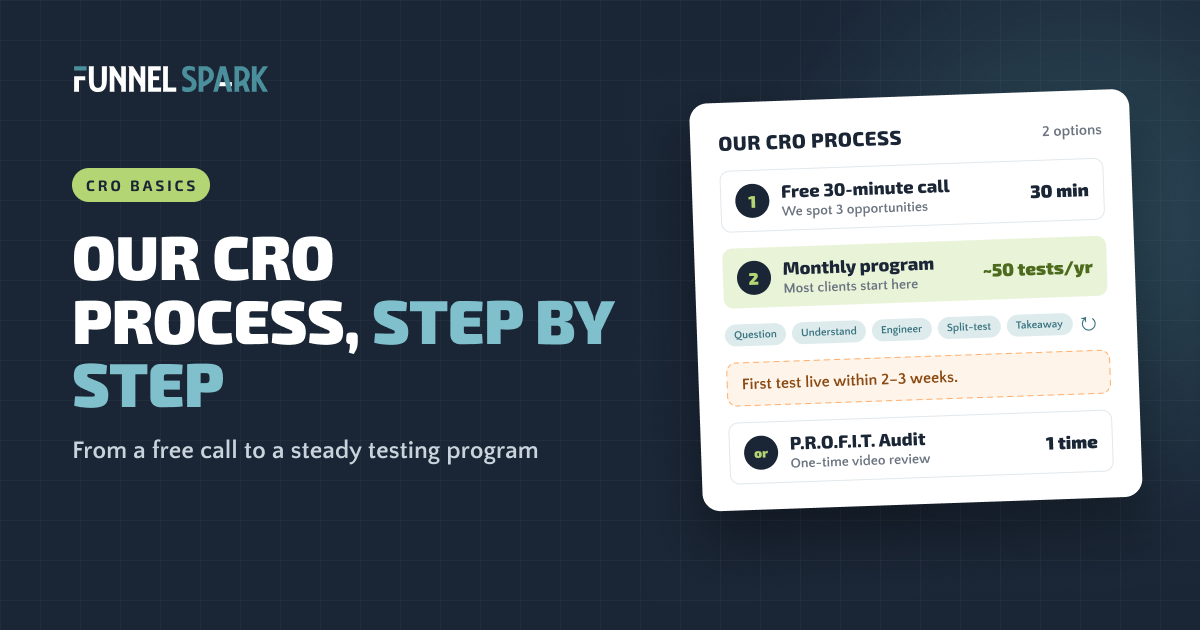
Our CRO process starts with a free 30-minute call where we point out 3 opportunities. Most stores then go straight into a monthly testing program that repeats 5 steps: question, understand, engineer, split-test and takeaway. Stores that aren't ready for a monthly program can get a one-time P.R.O.F.I.T. Audit instead.
What is a CRO process?
A CRO process is the set of steps you repeat to turn more of your visitors into buyers. Ours has 5: find where the opportunity is, understand why shoppers get stuck there, engineer a fix, split-test it, and take away what you learned. Then do it again.
Most stores try CRO as a list of tricks. Some help, some hurt, and nobody knows which. With a process, every change starts from evidence and ends with a measured result. If you're new to the idea, start with what CRO is, then come back here.
At FunnelSpark, an ecommerce CRO agency for Shopify stores, this is the exact process we run for every client. It's also the reason our tests win more often than most.
of our 1,000+ A/B tests beat the original, against an industry average of about 15%. A win means the new version beat the current page at 95% confidence on orders or revenue per visitor. Source: FunnelSpark test history.
Our CRO process at a glance
Everyone starts with the same free call. After that, there are 2 ways to work with us: a monthly testing program, which is how most clients work with us, or a one-time audit for stores that aren't ready for a monthly program. You don't need the audit to start the program.
The FunnelSpark CRO process
- 1. QuestionWhere is the opportunity?
- 2. UnderstandWhy might this be happening?
- 3. EngineerWhat change could solve it?
- 4. Split-testDoes the change really work?
- 5. TakeawayWhat did we learn?
- ↻ Back to step 1, with what the test taught us
Start here: the free 30-minute call
Every project starts with a free 30-minute call. We look at your store and your numbers together, and we point out 3 opportunities: places where we think you're losing sales and what we'd do about them.
It's also a fit check. We work with stores doing about $100k to $10M+ a year. We're a certified Shopify Partner, but we work on any platform. Nicolas leads the strategy on every account, so we take at most 5 new clients a month. At the end of the call, we'll tell you which option fits: the monthly testing program, or the audit if a monthly program isn't the right fit yet. And if testing won't pay off for you yet, we'll say so and tell you what to fix first.
Option 1: The monthly testing program, in 5 steps
This is how most clients work with us. Every month, the program proves what makes you more money by running a loop of 5 steps. Each step answers one question.
1. Question: where is the opportunity?
We start with the numbers, not the pages. Analytics show which step loses the most shoppers: product page, cart or checkout. We also look at traffic, because a fix on a page few people see won't move your sales. The answer is a short list of the places where a lift would be worth the most.
2. Understand: why might this be happening?
Next we find out why shoppers stop there. Heatmaps and session recordings show what they do before they leave. Surveys and user tests tell us what they were thinking. The best ideas come from shoppers, not from a brainstorm.
3. Engineer: what change could solve it?
Research gives us more ideas than we can test, so we rank them. Each idea gets a score for how much money it could make and how much work it takes. Big, easy wins go first. The exact scoring model matters less than the habit: never test whatever someone thought of last.
Most stores don't have an ideas problem. They have an order problem. The test plan makes sure the next test is the one most likely to pay for itself.
Then we write the copy, design the new version and build it in the testing tool. Nicolas signs off on every test before it goes live.
4. Split-test: does the change really work?
Before launch, we click through both versions on phones and computers: add to cart, open the cart, start checkout. A broken version "loses" for the wrong reason, and a good idea gets thrown away. Then the test goes live: half your shoppers see the current page, half see the new one, and it runs until the result is clear, never less than 2 full weeks.
5. Takeaway: what did we learn?
When a test ends, you get a short report in plain English: what we tested, why, what happened and what's next. We judge every test on orders or revenue per visitor, not clicks, and only call a winner at 95% confidence. Winners get rolled out. Losers still teach us something about your shoppers, and that lesson becomes the next question. Our guide to ecommerce A/B testing covers how we read results in more detail.
Option 2: The P.R.O.F.I.T. Audit
The audit is for stores that want an expert's eyes on their store but aren't ready for a monthly program. Nicolas records a video of about 60 minutes that walks through your store page by page and shows what he'd change and why. Your team then makes the changes.
The name is the checklist. Each letter is one of the 6 areas we review:
| Letter | Area | The question it answers |
|---|---|---|
| P | Page optimization | Is each key page clear, convincing and easy to use on a phone? |
| R | Revenue boosting | Are you leaving money on the table per order (add-ons, bundles, thresholds)? |
| O | Offer enhancement | Is your offer, price and guarantee presented in the strongest way? |
| F | Funnel analysis | Between which steps do the most shoppers drop? |
| I | Insights generation | What do your data and your customers say about why they leave? |
| T | Testing recommendations | Which tests should run first? |
The audit is yours to act on, with or without us. If you later decide you want the monthly program and start within 30 days, the audit fee is credited toward it. More details on the P.R.O.F.I.T. Audit page.
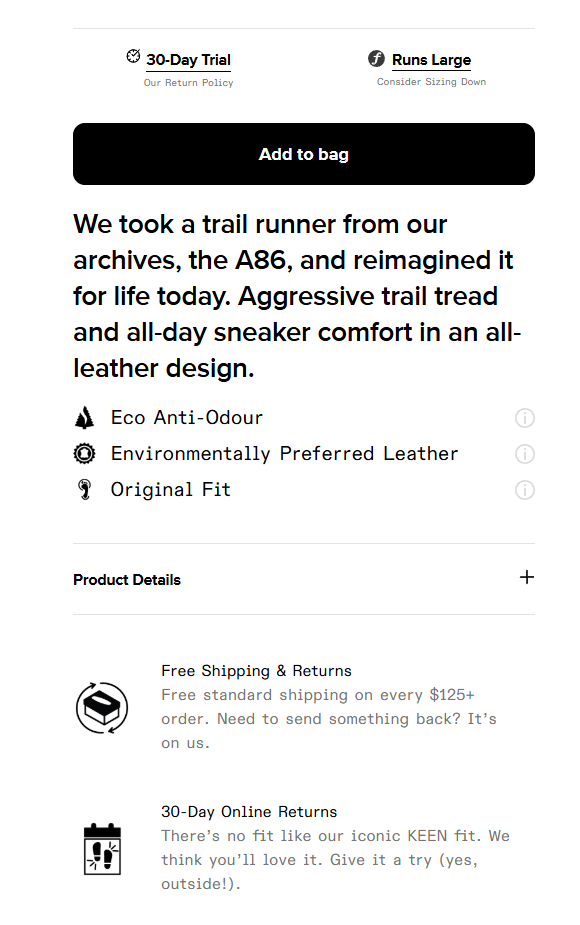
Here's the kind of thing a page-by-page review looks for. Only 9 of the 25 top stores we broke down show shipping or delivery details before checkout. KEEN is one of them:
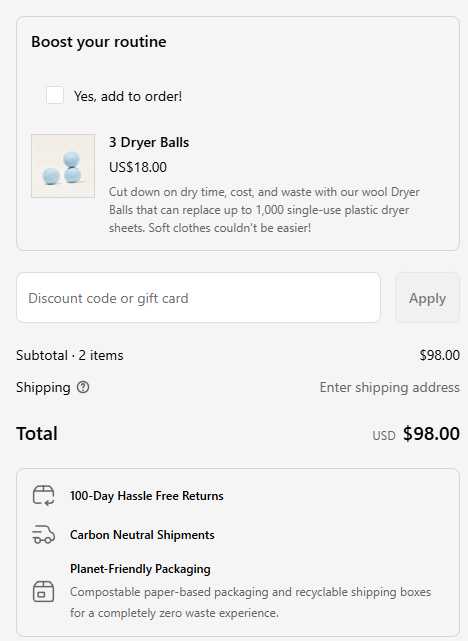
And on the revenue side, 7 of the 25 top stores we broke down offer an add-on (an order bump) right in the checkout. Blueland does it and repeats its promises under the total. On Shopify, adding custom text or offers inside the checkout steps needs Shopify Plus.
How long does the CRO process take?
CRO is a steady habit, not a one-off project. Here's the timing with us:
| Milestone | When |
|---|---|
| First test live | Within 2 to 3 weeks of starting the program |
| Each test | At least 2 full weeks, until it reaches the planned number of visitors |
| Tests per year | About 50 |
| Our promise | If there's no winning test by the end of month 3, month 4 is free |
What if your store doesn't have much traffic?
A/B testing needs a lot of visitors. At a 2% conversion rate, proving a 10% lift takes about 161,000 visitors in total. Many stores don't have that every month.
The process still works with different tools in step 4, split-test: user tests, concept tests, customer feedback and faster signals like add-to-cart rate. Bigger changes help too, because they're easier to measure.
What results look like
Across 200+ stores, this process has added more than $170M in extra revenue for our clients. A few public results:
| Result | Where we tested | Store |
|---|---|---|
| +74.6% orders | Homepage hero | Supplement brand |
| +41% orders | Entry lightbox | Meal prep |
| +32% orders | Mini-cart | Supplement brand |
| +23% orders | Header | Children's journal |
| +15% revenue per visitor | Navigation | Flooring |
| +12% orders | Product page | Car utility |
| $3.6M extra revenue | — | Canadian apparel brand |
| $2.2M extra revenue | — | Online rug retailer |
The wins came from many different pages. No single page always wins, which is why research comes first.
How to run a lighter version yourself
You don't need an agency to start. Here's the same process, cut down for a store owner with a few hours a week:
- Question: find the biggest drop. Write down your baseline first: conversion rate, average order value and revenue per visitor for the last 30 days. Then open the conversion breakdown in Shopify Analytics and see where most sessions stop: product page, cart or checkout. Our guide to getting traffic but no sales walks through it.
- Understand: watch and ask. Watch 15 to 20 session recordings at that step. Microsoft Clarity is free and includes recordings and heatmaps. Then ask 5 people to try buying from your store while thinking out loud. Jakob Nielsen of Nielsen Norman Group found that tests with 5 users uncover about 85% of usability problems.
- Engineer: list and rank your ideas. Give each one a score from 1 to 5 for impact and for ease. Start with high impact, high ease. Our ecommerce CRO checklist and our list of Shopify conversion fixes in the order we check them are good sources of ideas.
- Split-test: fix the obvious, test the rest. A hidden shipping cost doesn't need a test. New offers, prices and layouts do, if you have the traffic.
- Takeaway: keep a log. What you saw, what you changed, what happened. In a few months, it becomes your best source of ideas.
Want a head start on step 1? Our free Leak Finder walks you through 20 checks from homepage to checkout.
CRO process vs CRO strategy vs CRO framework
People mix these up. Here's the difference:
- CRO strategy is what you focus on and why: which pages, which shoppers, which goal (more orders, bigger orders, or both).
- CRO process is the repeatable steps you follow to get there. Ours has 5: question, understand, engineer, split-test, takeaway.
- CRO framework is a structure that keeps the work consistent, like our P.R.O.F.I.T. Audit or an impact-and-effort score.
If you'd rather have it run for you, that's what we do as an ecommerce CRO agency.
FAQ
There are 5. Question: find where the biggest opportunity is. Understand: research why shoppers get stuck there. Engineer: rank your ideas and build the best fix. Split-test: A/B test it against the current page. Takeaway: keep the winners and turn what you learned into the next question.
With us, the first test goes live within 2 to 3 weeks. Each test runs at least 2 full weeks, and the gains add up over months.
A CRO framework is a structure that keeps the work consistent. Some frameworks score test ideas by impact and effort. Others are checklists, like our P.R.O.F.I.T. Audit, which reviews 6 areas of a store.
Our P.R.O.F.I.T. Audit is a video review of about 60 minutes that goes through your store page by page, across 6 areas: pages, revenue, offer, funnel, insights and test recommendations.
Yes. A/B tests need lots of visitors (about 161,000 to prove a 10% lift at a 2% conversion rate). With less, use user tests, customer feedback and faster signals like add-to-cart rate.
Written by
Nicolas Fradet
Nicolas is the founder of FunnelSpark, an ecommerce CRO agency. He has spent 16 years finding out why shoppers don't buy, with 1,000+ A/B tests run and a 37% win rate. He wrote Stop Guessing. Start Converting.
Follow Nicolas on LinkedIn →Want us to find what's stopping your shoppers?
On a free 30-minute call, Nicolas looks at your store and shows you 3 growth opportunities, whether we work together or not.
Book your free call