Price testing on Shopify: how to test prices without losing margin
Why a price test can lose on conversion rate and still make more money, and how to run one on Shopify.

By Nicolas Fradet, founder of FunnelSpark · 16 years in CRO, 1,000+ A/B tests
Updated Nov 26, 2026 · 9 min read
The short answer
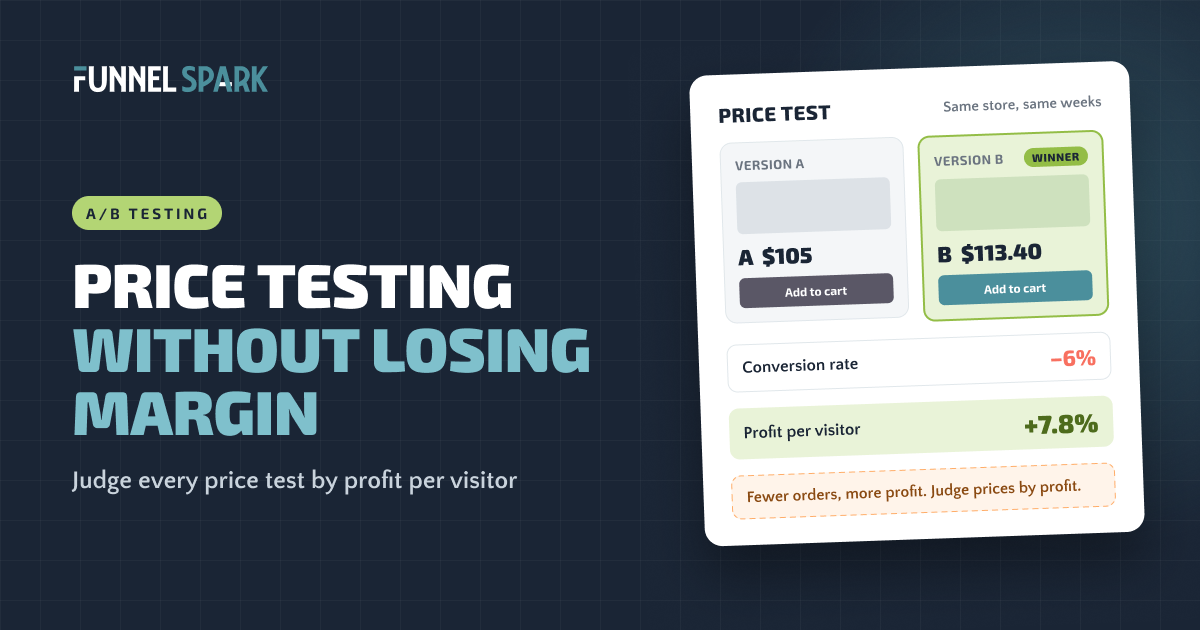
Price testing shows 2 prices (or shipping fees, or offers) to random groups of shoppers at the same time, then compares profit per visitor. On Shopify you need an app, like Intelligems, to keep each shopper's price the same from product page to checkout. Expect conversion to dip when prices rise. What matters is whether profit rises more.
What is price testing?
Price testing is an A/B test where the thing you change is what the shopper pays: the product price, the shipping fee, the free shipping threshold or the offer. Visitors are split at random into groups, each group sees its own price everywhere on the site, and you compare how much profit each group brought in.
It's not the same as a sale. A sale changes the price for everyone, so you never learn what would have happened without it. A price test runs both prices in the same weeks, so the price is the only difference.
Why price tests can be your most valuable tests
Most tests try to get more people to buy. A price test changes how much you keep from every order, and that money goes straight to profit. McKinsey's article "The power of pricing" works through the income statement of an average S&P 1500 company and finds that a 1% price rise, if volumes stayed stable, would lift operating profits by 8%.
Bring that down to a store. Take a $1.5M a year store with 60,000 sessions a month, a 2% conversion rate and a $105 average order. If 1% more on price cost no orders, that's about $15,000 a year of extra revenue, and almost all of it is profit, because product, shipping and ad costs stay the same.
Big brands sweat how a price looks. Of the 25 top stores we broke down page by page, 9 show a crossed-off price next to the sale price and 8 hide the cents. The number itself deserves the same care. Most stores set a price at launch and leave it alone for years.
Why conversion rate is the wrong scorecard
Raise a price and fewer people will usually buy. If you judge the test by conversion rate, the higher price loses almost every time. That's why we judge price tests by profit per visitor: what's left after product cost, shipping and payment fees, divided by every visitor in the group. It's one step past revenue per visitor, the metric we use for most tests.
Here's a worked example for the same $1.5M store. Version A keeps the $105 price. Version B charges 8% more, $113.40. Each order costs $36 in product, $10 in shipping and packing, and 2.9% plus 30 cents in payment fees. Say version B loses 6% of its orders.
Version B sells less and makes more
Conversion rate B is 6% lower
Revenue per visitor B is 1.5% higher
Profit per visitor B is 7.8% higher
A: $105 (current price)B: $113.40 (8% higher)
The math, per month (60,000 sessions)
| A: $105 | B: $113.40 | |
|---|---|---|
| Orders | 1,200 | 1,128 |
| Revenue | $126,000 | $127,915 |
| Cost per order | $49.34 | $49.59 |
| Profit per order | $55.66 | $63.81 |
| Profit | $66,786 | $71,979 |
B makes $5,193 more a month, about $62,000 a year, on 72 fewer orders. Ad spend is the same for both groups, so it doesn't change which one wins.
Now turn it around. With these costs, the 8% higher price keeps making more money until it loses about 13% of orders. An 8% price cut needs about 17% more orders just to break even. Cuts are harder to win than most owners think.
A higher profit per order also raises what you can pay for a customer: see our guide to break-even ROAS.
4 ways to run a price test on Shopify
Shopify doesn't show 2 prices for the same product at the same time on its own. Intelligems, a Shopify price testing app, says as much on its blog.
| Method | Best for | Watch out for |
|---|---|---|
| App-based price test | Testing the price itself on your main products | App cost, setup with your theme and feeds |
| Duplicate product | Paid traffic to a landing page, bundles, subscriptions | Split reviews, inventory and SEO |
| Shipping test | Thresholds and shipping fees | Some rate tests need a higher Shopify plan |
| Offer test | Keeping your list price and testing the deal | Offer costs that eat the gain |
1. An app-based price test
This is the cleanest way to test the price itself. According to Intelligems' docs, its main method sets your Shopify prices to the highest price in the test, then uses a Shopify Cart Transform Function to lower the price for shoppers in the other groups. The docs say this works on any Shopify plan and that the shopper sees the same price in the cart and at checkout that they saw on the rest of the site. Its docs list price testing on the Smart Pricing and Unlimited plans.
Load your product costs first, so the app can report profit per visitor for each group.
2. A duplicate product (split URL)
You copy the product, give the copy the new price, and send half your traffic to each. Intelligems' docs say it uses this route for more complex tests and for stores with subscriptions. Done by hand, it suits paid traffic to a landing page, where you control the link. The catch: the copy has no reviews, can show up in collections and search, and splits your inventory. Hide it and keep the test short.
3. A shipping test
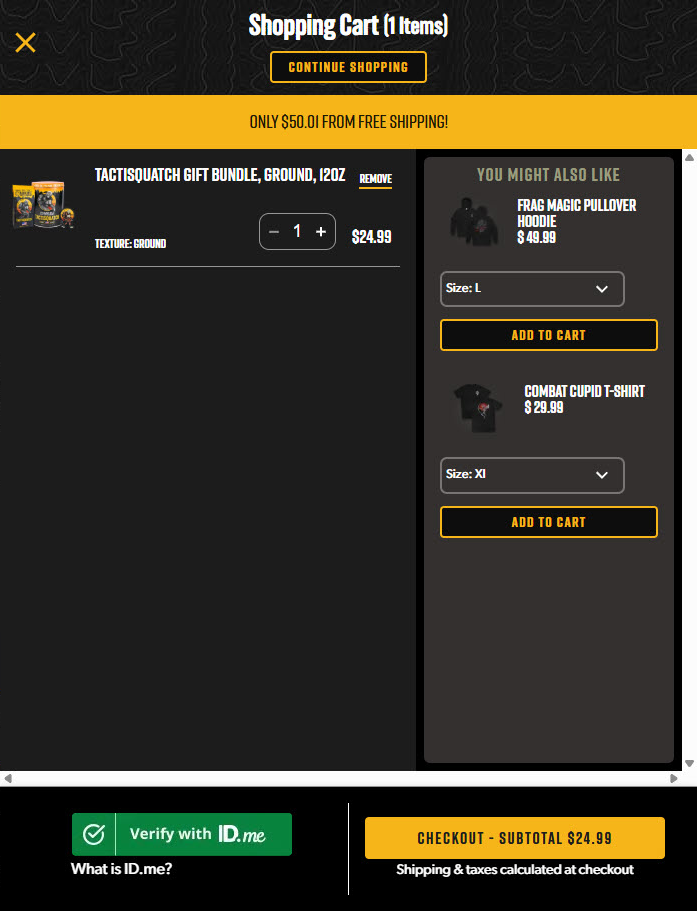
Shipping is a price too. Test the free shipping threshold, a flat fee against free shipping, or a cheaper rate above a cart value. Of the 25 top stores we broke down, 15 show a free shipping threshold or confirm free shipping in the cart or checkout. Our guide on how to set your free shipping threshold shows how to pick the levels to test.
Plan note: Intelligems' shipping docs say tests that replace your shipping rates need Shopify's Advanced or Plus plan. Its free shipping and shipping discount tests leave your Shopify rates as they are.
4. An offer test instead of a price test
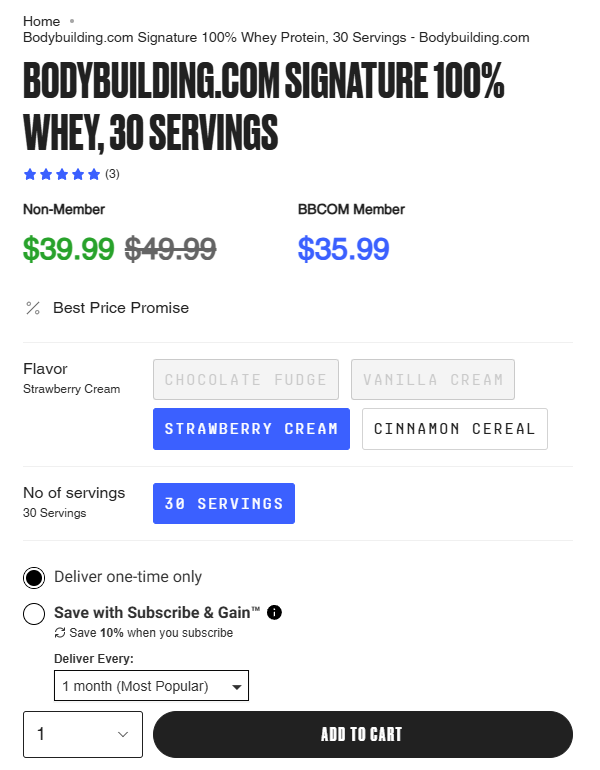
Don't want to touch the list price? Test the deal around it: a bundle, a subscribe and save discount, a member price, or a free gift above a cart value. Everyone sees the same list price, so it's the gentlest test for shoppers. Count the offer's cost in profit per visitor, or a "winning" offer can quietly lose money. Our ecommerce discount strategy covers which offers protect margin.
How much traffic does a price test need?
More than most page tests. A price change usually moves conversion by a few percent, and small changes take a lot of visitors to tell apart from luck.
Visitors you need in each group, at a 2% conversion rate (estimate)
| To spot a change in conversion of | Visitors per group |
|---|---|
| 6% | 220,000 |
| 10% | 81,000 |
| 15% | 37,000 |
| 20% | 21,000 |
Our estimate, using the standard sample size formula for 2 conversion rates, with 95% confidence and 80% power. A drop needs slightly fewer visitors than a rise of the same size.
Our example store gets about 55,000 sessions in 4 weeks, so about 27,700 per group. That's enough to spot a change of about 16 to 17% in conversion rate, not the 6% in our example. Here's how to make a price test work at that size:
- Test where the traffic is. Your best sellers or the whole catalog, not one quiet product.
- Use 2 groups, not 4. Every extra price splits your traffic again.
- Make the step big enough to matter. Intelligems' blog says a typical test puts a lower and a higher price 5 to 10% away from the current one. With less traffic, stay near the top of that range.
- Run it longer. 4 to 6 full weeks, not 2.
If the result still isn't clear, it means the difference is smaller than your test could see. That's useful to know, but it isn't proof the higher price is safe. For the full sample size picture, see our guide to ecommerce A/B testing.
How to run a price test, step by step
- Pick the products. High traffic, healthy margin, no sale or launch planned.
- Pick the prices. One step, sized for your traffic. Write down how many orders the new price can lose (or must gain) before it loses money.
- Make ads and emails price-free. Intelligems' blog warns that an ad showing one price, landing on a page with another, "breaks the test and the experience." The same goes for Klaviyo emails and Google Shopping feeds.
- Brief your developer or agency. Check prices hardcoded in the theme, bundles, upsell apps, subscriptions and Shop Pay. Click through both groups on mobile and desktop, up to the payment step.
- Run full weeks, away from big sales. Intelligems suggests at least 2 weeks, ideally closer to 3. With mid-size traffic, plan for 4 or more.
- Decide on profit per visitor. Then check refunds, support tickets and repeat orders in the weeks after, and roll out the winner.
Is it fair to show shoppers different prices?
Shoppers do compare notes. In a statement in September 2000, Amazon said it had refunded 6,896 customers an average of $3.10 after a random DVD price test, and that if it ever ran one again, it would give everyone who bought a test item the lowest test price.
We're not lawyers, and the rules depend on where you sell, so check with yours before you run one. Here's how we keep price tests fair:
- Split at random. Never price by who the shopper is, where they live or what device they use.
- Keep the price consistent. Same price on the product page, in the cart and at checkout, every time the shopper comes back during the test.
- Honor the lower price. If a shopper asks why a friend paid less, refund the difference. Tell your support team before the test starts.
- Don't fake a sale. A test price is not a "was" price. Don't show a crossed-off price that nobody ever paid.
At FunnelSpark, an ecommerce CRO agency for Shopify stores, we've run 1,000+ A/B tests, and 37% of them beat the original. The tests that move profit most are often about what the shopper pays. If your store does $100k+ a year, or you run ecommerce in-house, book a free 30-minute call and we'll help you pick the price test worth running first.
FAQ
Price testing is an A/B test of what shoppers pay. Random groups of visitors see different prices, shipping fees or offers at the same time, and you compare the profit each group brings in per visitor.
Yes, with an app. Shopify doesn't show 2 prices for the same product at the same time on its own. Apps like Intelligems keep each shopper's price the same from the product page to checkout.
At least 2 to 3 full weeks, and longer if your traffic is modest. A store with 60,000 sessions a month should plan for 4 to 6 weeks. Avoid big sale periods like Black Friday.
It depends on where you sell, so check with a lawyer before you run one. We can't give legal advice. Keep it fair: split at random, keep each shopper's price the same through checkout, and refund the difference if a shopper asks.
Profit per visitor: revenue minus product, shipping and payment costs, divided by every visitor in the group. Conversion rate usually drops when prices rise, so it steers you toward prices that are too low.
Written by
Nicolas Fradet
Nicolas is the founder of FunnelSpark, an ecommerce CRO agency. He has spent 16 years finding out why shoppers don't buy, with 1,000+ A/B tests run and a 37% win rate. He wrote Stop Guessing. Start Converting.
Follow Nicolas on LinkedIn →Want us to find what's stopping your shoppers?
On a free 30-minute call, Nicolas looks at your store and shows you 3 growth opportunities, whether we work together or not.
Book your free call